About 200 of San Diego City College’s faculty, staff and students gathered for a moment of silence for the victims of the Umpqua Community College shooting in Oregon on Oct. 8 in Gorton Quad.
The moment of silence at City was a part of a larger observation coordinated by the American Association of Community Colleges, according to The San Diego Union-Tribune.
“I think it’s for all of us to be aware that safety is all of our business. Safety is something that we all ought to be aware of. We can’t just rely on a certain group of people but we all have to be aware of safety at the college and we have to be the eyes and ears for the police department,” City College President Anthony Beebe said. “It’s a big campus; it’s 60 square acres here and the only way that we can have the entire place covered is if all of us take a little bit of responsibility in making sure that we report anything’s weird or suspicious like I was saying and making sure that somebody’s aware of it. Don’t just turn your back and walk away. We can’t do that; we have to be responsible for that. That’s the critical piece of it.”
In his President’s Waypoint newsletter, Beebe addressed the tragedy at Umpqua and recalled the time he spent in Roseburg, Oregon, as a firefighter just one mile from the community college.
“… No one could have imagined that some 40 years later, the small community college just a mile down the road from that station would become the site of the most deadly mass shooting in Oregon history,” Beebe wrote.
San Diego Community College District Chancellor Constance M. Carroll also released a statement to the district’s faculty and staff on the shooting on Oct. 1.
“Our thoughts, best wishes, and support have been extended to our colleagues at Umpqua for what they have suffered today and for the valuable and promising lives that have been lost,” the statement said.
Carroll also referred to a YouTube video entitled “RUN. HIDE. FIGHT. Surviving an Active Shooter Event.” The almost six-minute video shows what options people could have in a potential active shooter situation.
“… Coping with an active shooter situation is a matter of personal decision,” Carroll wrote in her statement. “Therefore, I am resending the video that was previously distributed and discussed at our campus and departmental meetings.”
On Oct. 6, President Beebe sent a follow-up email to City College faculty and staff thanking them for the outpouring of responses he received from his President’s Waypoint.
In the email, Beebe tells faculty and staff that he met with Chancellor Carroll before the weekly Chancellor’s Cabinet meeting to address everyone’s concerns.
Beebe also mentioned that he also brought up those concerns during the Chancellor’s Cabinet meeting.
“In the end, the Chancellor’s Cabinet was unanimous that the district move forward with the following 12 point safety response plan for City College,” Beebe said via the statement.
The 12-point safety response plan includes the hiring of two full-time City College officers, police forums and town hall meetings, safety and evacuation plan, safety surveys and “Knight Patrol,” paid student ambassadors who will act as the eyes and ears of administration and College Police, according to the email.
On Oct. 1, Christopher Harper-Mercer fatally shot nine people and injured nine others in a rage-filled attack on Umpqua Community College in Roseburg, Oregon.
With this event still very fresh in everyone’s mind, it begs the questions: What if this happens at San Diego City College? Are students, staff and faculty prepared? Is there a plan?
Memories of evacuation and disaster drills are far gone in most of the minds of current City College students and most students currently have no experience with drills dealing with active shooter situations.
In light of this recent tragedy, it’s evident now more than ever that City College needs a plan. Not a plan that’s talked about through email to administrators and never really put into action but a plan that’s known by students, staff, faculty, administrators and everyone who attends City on a regular basis.
A YouTube video entitled “RUN. HIDE. FIGHT. Surviving an Active Shooter Event,” linked to San Diego Community College District’s staff and faculty in an email by Chancellor Constance M. Carroll, shows three different ways people can deal with a potential active shooter situation.
In the Oct. 1 email, Carroll said that this particular video was discussed and distributed in departmental and campus meetings, which would mean that this issue would have been discussed long before the recent shooting in Oregon.
Why wasn’t any of this information or this video shared with students?
According to the 2014 edition of the City College Fact Book, the campus had 16,737 students in the spring 2014 semester. With thousands of students spread out over an open campus spanning 60 acres, you would think that some type of disaster preparation drill would have been shared with students at this point.
Students are usually told to just to report suspicious activity to the Campus Police or the San Diego Police Department wherever and whenever they see it on campus. The population at City College needs something more than “alert the police.” Alerting the proper authorities is a great idea, but we need to be aware of what else we can do when a major catastrophe happens. We need a plan of action. We need to have some ideas on what we can do during potentially dangerous situations.
The “RUN. HIDE. FIGHT.” video should have been shared with students. Not just shown and discussed at campus and departmental meetings. Showing and discussing with administration doesn’t really help if something were to happen on campus.
At the end of the day, it’s better to have a plan and not use it than to be left unprepared if something happens at City College.
A look behind the curtains of the San Diego music scene
In an unsuspecting corner of a normal street, inside a
normal looking venue is a simple layout — A stage and a small capacity area
for concertgoers. Band after band cross
the stage, setting up their instruments while a sound engineer makes sure they
have the proper levels and sound. Music floods the room and the people, mostly
teenagers and young adults, move to the rhythms that pass through the speakers.
This is the San Diego music scene. Off the beaten path of
bigger and more well known venues like the Observatory, SOMA and the Irenic or
the age 21 and up establishments like Soda Bar and The Casbah. It’s the smaller
capacity venues that house 50 to 100 people and book almost exclusively local
bands that’s the heart of the music scene in America’s Finest City. It’s also
one of the biggest problems plaguing the budding scene, according to Zane
Shrem-Besnoy, a local promoter and musician.
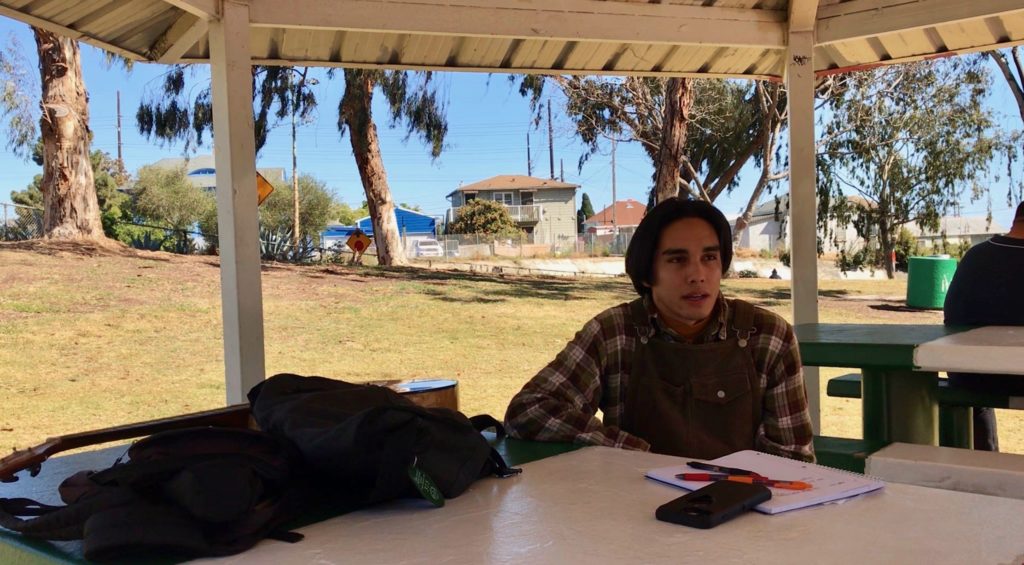
Local promotor and musician Zane Shrem-Besnoy at Liberty Station on March 21. Photo by Angelica Wallingford
“There needs to be more like 100 capacity rooms,”
Shrem-Besnoy explained. “Che Café has a capacity of like 150 which is
perfect…it doesn’t feel empty if there’s only 50 people in there and a lot of
local bands that’s what they could pull; about 50 people.”
However, the smaller capacity venues are few and far
between, which Shrem-Besnoy says is the one of the reasons why bands, artists
and producers who currently call San Diego home might pack their instruments
and head north to the thriving scene in Los Angeles.
THE HOMETOWN TRIO
One of the many hometown bands playing the scene and gaining traction is glow!. The trio, made up of San Diego State University Jewish Studies major Sophie Parker, Dagger De La Vergne and Johnny “Blaze” Hurst, have writing together since May 2018.
Before the powerhouse trio became known as glow! around the scene, the members were heavily involved with had other musical projects. Sophia and Dagger met in 2015, started writing music together soon there after and started a band called Trouter Space. However, after De La Vergne moved to Utah for a short period of time, Trouter Space became less active. It wasn’t until he came back summer 2018 and moved in with Sophia that the genesis of glow! began to form.
“I had a lot of songs that were solo songs that I didn’t
know what to do with because I really wasn’t doing the Trouter Space thing as
much anymore,” De La Vergne said. “When I came out here I was living with her
(Sophia) because I didn’t really have a place to stay and we just put all the
songs together.”
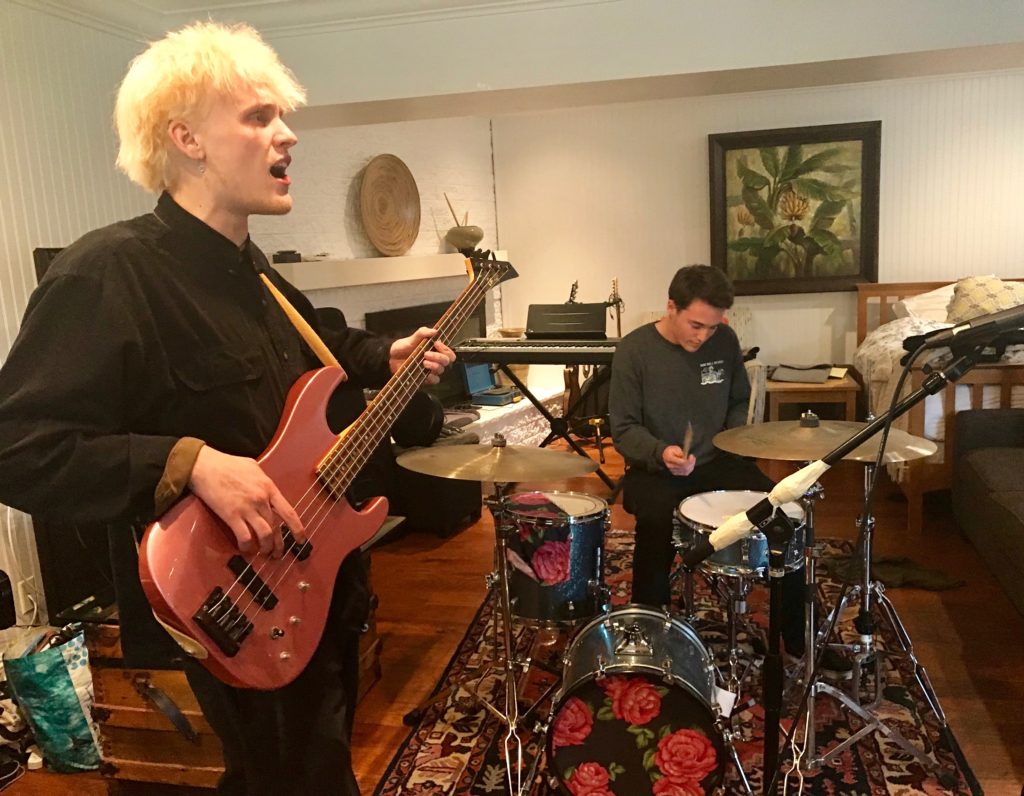
The members of glow!, Dagger De La Vergne, Sophie Parker and Johnny “Blaze” Hurst, respectively rehearse during a session on April 5. Photo by Angelica Wallingford.
The duo was looking for a drummer when De La Vergne met
Hurst at a Street Surfers and Foxhide show at local venue Queen Bee’s. Hurst,
who has a background playing for other local bands in San Diego, also knew
Sophia from high school. With the addition of Hurst, the band has been playing
shows since December and consistently writing songs since May 2018.
“We just like clicked and he started playing drums for us
and the whole band just came together at that point,” De La Vergne said. “He
just added a million times more dynamic…”
In a house atop a hill in La Mesa a residential space is
turned into an impromptu rehearsal area. In between the couch and the TV stand
sits a drum set. To the right of the front door, chords wind the hardwood floor
plugged into the amplifiers and tuners. Next to the amps, lone microphone stand
where Parker and De La Vergne will switch lead vocals come practice time.
Amongst the chaos of chords and guitar pedals, Hurst sets up
his drum kit placing a shirt as a muffler atop his snare, which he later tosses
aside before playing one of the band’s songs. He runs through the percussion
part of a song that he was working on before they jump into their first song
for the hours long rehearsal.
The band’s experience in the local music scene has been
overall a good experience, De La Vergne claims. The problem, he says, lies
within the organization of shows and the lack of venues to showcase local
artists.
“Collectively, I think there’s a lot of good music that
comes from here and I love a lot of the bands that come from here,” De La
Vergne said. “At the same time it is pretty messy and inconsistent, not
together and not really organized.”
FEW AND FAR BETWEEN
The band points to something that is usually central to a thriving music and arts scene: venues, or in San Diego’s case, a lack thereof.
“If you’re a local band and you’re looking for a venue it’s such an uphill battle,” Shrem-Besnoy said. “There’s just not venues… and I think that’s why the music scene has such a hard time getting legs.”
One of the main problems the members of glow! point out is the
seemingly impossible list of requirements that bigger venues have in order for
bands to play there. The perspective of bands and artists with smaller
followings, the bigger venues tend to focus more on the money the can make from
a show rather than just getting the music out there. How many people can the
band get to attend and presale tickets are just some of the factors that can
make or break a band playing these bigger venues.
One solution that many local groups have come up with to
combat the lack of venues is to create their own in the form of house shows.
Turning their living space into a functioning venue, holding the capacity
crowds that would have otherwise turned up at these smaller venues like the Che
Café.
“It’s kind of inhibiting to people like us who are smaller
trying to get our name out there, we have all these requirements that we don’t
meet for them,” Hurst said. “Everybody is doing house shows because all the
venues around here are way to demanding.”
Promoter Héctor Castro, 19, at Chicano Park discussing the San Diego music community on April 18. Photo by Angelica Wallingford
When the Che Café closed for renovations a few years ago,
19-year-old promoter Héctor Castro didn’t know where he could throw shows that
the longtime San Diego establishment once held on a regular basis but also
bring together the community that once frequented these shows.
“That really put a roadblock for us because we love to
perform, we love to throw shows, we love to have spaces where people can hang
out, where we can see our friends,” Castro said. “We didn’t know where to go,
so we started throwing house shows.”
While house shows have become a mainstay across San Diego
County, it comes with it’s own set of problems. The main being that these DIY
shows are located in residential areas and often times can be unorganized, De
La Vergne said.
Kalani Lomu, formerly of longtime San Diego band Bad Kids, has been active in the scene since 2011 and has played in most of the venues scattered throughout San Diego. For Lomu, it’s not the lack of venues that are the problem; it’s the lack of all-ages venues that are the real issue since most bars can double as a performance space.
“The young kids make up a lot of the show goers in the scene and yet there’s like three all ages venues,” Lomu said. “For young bands it’s really not fun being escorted into the venue by the bouncer and then have you kicked to the curb after your set.”
MONEY TALKS
Aside from the lack of venues being an issue for most bands,
another issue is the music business in San Diego and the lack of accessibility
for people of all backgrounds to participate, according to Castro.
“I live in San Yisidro, I’m not rich, I’m not even in the
middle class, I’m not even in the low middle class. I can’t afford to throw
$1000 into shows,” Castro said. “It would be amazing to have smaller spaces
that can see that and say ‘we have money, we have these promoters that can help
you throw these shows and have them happen, we can have spaces that help you
have a performance,’ it would be amazing if we had more of that because we
don’t.”
The issue of profiting from artists isn’t something
particularly new when it comes to music scenes anywhere. The concept of “pay to
play” has been used in venues for so long that it’s become almost expected and
is something that Shrem-Besnoy disagrees with completely.
Dagger De La Vergne and Johnny “Blaze” Hurst practice during an April 5 session. Photo by Angelica Wallingford
“These people come out to see the bands on the stage,”
Shrem-Besnoy said. “They (the bands) deserved to get paid because if it wasn’t
for them people wouldn’t be coming to the venue.”
Castro started producing shows when he was 17, at the time
he considered it to be a great opportunity because he knew the bands he was
booking and the venues to hold the events. At that time, because of his
connections, it didn’t cost anything for him to put on an event.
However, with his past two shows he decided to invest about
$600 of his own money to create an ambiance for his productions that other venues
wouldn’t have otherwise been able to accommodate. Castro took it as a risk
because he didn’t know whether he would make a return on his investment and pay
out the bands that performed.
“It is kind of a weight on me because I know that if no one
shows up, I’m going to have to pay out of my pocket and I end up losing money
and hurting me,” Castro said. “It scares me from throwing more shows because I
don’t know if its going to be helpful for the community or I’m just going to
crumble down and not be able to give more to the community.”
COMMUNITY THROUGH DIVERSITY
For Castro, Shrem-Besnoy, Lomu and the members of glow! the
San Diego music scene is more than just a bunch of artists showcasing their
work, it’s a community with music just as diverse as the people that make it.
Johnny “Blaze” Hurst and Sophie Parker, members of the local band glow!, rehearse in a converted living space on April 5. Photo by Angelica Wallingford
“One thing about San Diego is that there’s everything here.
Going off of bands there’s Beach Goons, they’re like surf rock. You have
hardcore bands like frontside… You have things like Sestivity, which is going
in a new direction that mixes keyboards and MIDI controlled sounds into their
punk music. And then you just have contemporary rock such as Street Surfers,
Wizard and all those guys. Then you have rappers, 1207 is huge,” Hurst said. “They’ve
made a name for themselves all out of San Diego.”
While San Diego’s music scene might not be as big as the one
in Los Angeles, it doesn’t mean that the culture isn’t there and music plays a
huge part in that, Lomu claims.
“There’s so much different music coming out of this place
it’s honestly hard to keep track of,” Lomu said. “We might not be known as a ‘music
city’ but honestly we probably should be.”
glow! band profile. Filmed and edited exclusively on iPad Pro.