Friends of SDSU launches drive to put SDSU West on 2018 ballot

Friends of SDSU, a group dedicated to a ballot initiative for the creation of a new west campus for San Diego State on the current site of SDCCU Stadium, began its signature gathering efforts Oct. 21, the day of the university’s homecoming football game.

The group hopes to get the SDSU West Campus Research Center, Stadium and River Park Initiative on the November 2018 ballot. The initiative would allow for the sale of much of the SDCCU Stadium site to SDSU, freeing the university to build a satellite campus in Mission Valley that could potentially include student housing, research and technology facilities, a river park and a new multi-use stadium.

The choice to start signature gathering during the culmination of San Diego State’s homecoming festivities wasn’t a deliberate one, but rather one of serendipitous timing, said SDSU West spokesman Fred Pierce.

“It coordinated perfectly with our schedule,” Pierce said. “We had a 21-day notice period where when we published the initiative, we had to actually print it in the newspaper. And it just so happened that when we looked at the schedule, 21 days ending up on homecoming was perfect timing.”

For the initiative to appear on the 2018 ballot — alongside the rival SoccerCity plan — it needs to receive more than 71,000 signatures from San Diego residents by the end of December. The group anticipates a healthy level of support, especially from alumni.

“One in seven college graduates in San Diego attended SDSU,” Friends of SDSU steering committee member Gina Champion-Cain said in an Oct. 20 press release. “We’re hoping to see these proud alumni at the game and convert their support of the university into a signature for its future.”

The group had booths set up at various places around SDCCU Stadium before Saturday’s football game, staffed with dozens of signature gatherers and flyers about the initiative for uninformed or interested voters.

One signature gatherer, Stephanie Mercy, said she believes San Diego needs a sports team and could see SDSU West as a viable option, but that she’ll hold out until both the initiatives are released for San Diegans to make the final decision.

“At this time I don’t know, let’s see both proposals and make a decision on Election Day,” Mercy said. “It’s a way of giving us choice and I’m all about choice.”

However, the stadium is just the beginning. Pierce said SDSU is landlocked, and that expansion would not only bring more potential students to San Diego State, but more innovation in research, technology and business.

“We need room for growth for new students, we need growth for research activities, technology transfers and business incubation,” Pierce said. “We also need a new football stadium. It’s been threatened that they are going to tear down Qualcomm and the stadium that the opponent initiative, SoccerCity, has proposed doesn’t work.”

Pierce cited the large stadium attendance from this season as a prime example why he believes SoccerCity’s stadium plan isn’t a viable option. SoccerCity’s stadium only allows for 30,000 seats, less than half of the over 70,000-seat current stadium.

The stadium seems to be the turning point for potential voters. Longtime SDSU football and Major League Soccer fan Jose Flores said he is leaning toward SDSU West but wants to hold out to see stadium renderings before making a final decision.

“Being a fan of both (SDSU football and Major League Soccer) I’m kind of torn,” Flores said. “It seems like SDSU West would have the bigger stadium and it could cater to both sports but I would love to see what the designers come up with before making my mind up.”

Along with SDCCU Stadium, signature-gathering efforts also launched at different locations around the city, with nearly 75 signature gatherers available to share information with voters, Friends of SDSU said.

Originally Published in The Daily Aztec in October 2017.

Life behind the screen(writer)

Longtime San Diego City College screenwriting professor Russell Redmond recalls his adventurous life in TV, cinema and education

In the quiet corner of the first floor of the L building, students stagger out into the unusually hot September sun on their last in-class session of Introduction to Screenwriting class. Left behind was a their teacher, longtime San Diego City College professor and screenwriter Russell Redmond.

“Russell is very patient, and you can gather the fact, especially when it comes to the attention given,” Erny Rivera, a student enrolled in Redmond’s online Introduction to Screenwriting class said. “Writing is still a delicate craft, to which Russell helps transform into an artform.”

Underneath Redmond’s casual demeanor lies a fun and energetic man with a passion for all things cinema and storytelling. Sitting behind a small desk in L-108 he began to recall his colorful journey to that lead to his love of film and teaching screenwriting at City; starting with his love of stories.

“I was always interested in storytelling,” Redmond said. “You know, you grow up watching TV as a little kid and you go ‘oh, that looks like fun’ and it seems exciting and so you proceed down that avenue thinking ‘maybe I’ll be interested in that’.”

He recalled going through high school and being in that phase all young men and women go through and figure out what they want to do with their future.

“…You have to decide (and say) ‘well, you know I think I really have a burning desire to get into film’ and of course everybody want to be not only an actor but a film director or someone else,” Redmond said. “I mean they want to do everything… and that was me.”

After graduating high school Redmond left Carlsbad and headed north to attend the University of California, Los Angeles (UCLA). After he graduated in 1973, Redmond received an offer from his screenwriting teacher, so he packed up and headed to Europe where he wrote for the BBC show “The Old Man’s Blood.”

After his run writing for the show, he moved to the European film capital of Almeria to work on a screenplay about “The Little Prince” author Antoine de Saint-Exupery and work as an extra in Spanish Western films starring Jack Palance and others.

During his stay in Almeria he was approached by director Sergio Corbucci, best known for his Spaghetti Western films and being a protege of Sergio Leone, to star in a film called “The Three Man War.”

“… It’s was a modern World War II movie where there’s three characters: a German, an Italian an Englishman; and it’s set in the desert of Libya but of course we’ll shoot it here in Spain,” Redmond recalled. “There was an interesting plot about it but there was only three characters in it. One of them was going to be Peter O’Toole, the other was Anthony Quinn and the other third one was going to be me.”

Funding for the film eventually fell through, however, before Redmond learned of that he boarded a plane and headed home to the United States where he got an agent and wrote more screenplays. About a year after he returned to the U.S. he dropped out of the film scene and became an illustrator in San Diego and Los Angeles for 10 years.

In the ‘90s Redmond struck up a friendship with City College professor Hope Shaw, whom he and his wife had met while sailing through Mexico working on various projects. Shaw became a great friend and told Redmond that she wanted to retire and if he would be interested in taking on one of her screenwriting classes.

“I said ‘no way, me teach, you’re crazy’ I mean no way I was going to do that,” Redmond said. “I just thought that was the worst Idea and that woman could talk anyone into anything. She was good; and by God she talked me into it and I finally said ok, I’ll do this one class and I went in there and I realized that this isn’t so bad.”

When Shaw died Redmond was asked to teach both sections of the Introduction to Screenwriting class, where he enjoys talking about films with his students.

“You end up talking about stuff that you should be remembering all the time you know you go back to beginning screenwriting and you start talking to kids about characterizations and how you should structure your film and motivations…’” Redmond said. “…you’re really getting in there, in the nitty gritty of the ‘this doesn’t work and that doesn’t work’ so you’re thinking about film structure all the time.”

RTVF department chair Laura Castaneda has worked with Redmond since she started as a part-timer at City College in 2000.

“It’s such an incredible experience (working with him),” Castaneda said. “He’s such an interesting person with an interesting perspective on life.”

Currently, Redmond has a short film out called “El Camino,” based on a true story about an undocumented woman’s journey through rough terrain to get back to the U.S. after visiting her sick father in Mexico, which he released through his production company Work With Me Films and hopes to make a feature film out of it here in San Diego in the near future.

Originally published in City Times, January 2016.

Paris attacks hit home

Parisian born San Diego City College professor Philippe Patto shares his reactions and thoughts on the Nov. 13 Paris terror attacks

On the night of Nov. 13, one of the deadliest attacks on French soil since World War II occurred in multiple locations across Paris and Saint-Denis claiming more than 132 lives.

Meanwhile, 5,000 miles away, San Diego City College professor Philippe Patto was in a park with his husband walking their dog when he heard the news that his hometown was under attack.

“My husband had the phone and he got beeped for an alarm,” Patto said. “He checked and he told me the news and right away.”

Patto heard from a friend in France via email about the situation but had poor reception so he and his husband went back home.

“We had the headline and I was devastated when I heard,” Patto said. “I didn’t know what was happening.”

The attacks started at approximately 9:20 p.m. French time and lasted until 9:53 p.m.

The three suicide bombers detonated an explosive belts near a gate and on the outside of the Stade de France stadium during an international soccer game, according to Reuters. A fourth suicide bomber detonated another bomb in Le Comptoir Voltaire restaurant, killing himself and injuring one person.

In the midst of the several suicide bombers detonating their explosives, gunmen opened fire in the front of the A La Bonne Biere bar and the terrace of the La Belle Equipe restaurant, killing a total of five people and severely injuring 18 more, Reuters also reported.

The deadliest of the terror attacks happened during an Eagles of Death Metal concert at the Bataclan theater and concert hall where gunmen opened fire on the crowd killing 89 people and injuring many others.

Luckily, Patto had no family in the area during the attacks.

“When it happened, I didn’t think it would affect me this much and it really hit me hard, I’ve been trying to grasp what happened,” Patto said. “What shocked me the most was that it took place in France.”

French President Francois Hollande has called the terror attacks an “act of war” and places blame on the Islamic State (IS).

“France will be merciless in its response to the Islamic State militants,” Hollande said, according to the BBC. “(France) will use any means within the law … on every battleground here and abroad together with our allies.”

While the culprits responsible for act remain unknown, IS has taken credit for the attack stating that “eight brothers wearing explosive belts and carrying assault rifles” attacked “carefully chosen” individuals, according to the BBC.

Patto feels that Hollande’s instant reaction to the attacks was expected and that as a leader Hollande wanted to show the French people that the government was doing something and that those responsible wouldn’t just get away with it.

“I’m just hopeful that we will not take drastic measures and go into war with somebody,” Patto said about the possibility of France entering into war. “We don’t even know where they are, we don’t even know who they are.”

Patto hopes that the end result will be a well balanced one and that Hollande will reach out to other countries so that attacks of this magnitude will not happen not only to the French people but anyone around the world.

The attacks sparked a great debate over admitting Syrian refugees not only in the United States but around the world. Since the attacks, Congress swiftly passed a bill that suspended the admittance of both Syrian and Iraqi refugees into the U.S. and 31 governors oppose accepting Syrian refugees into their states, according to CNN.

“That is fear,” Patto said “As long as we react out of fear we are not any different than the terrorists.”

“I think it’s wrong for the government to implement such drastic measures like that,” student Raul Flores said about congress’ decision. “You can’t place all the sins of the attackers onto the refugees, they can’t be condemned for what the attackers did.”

In contrast to the U.S., Hollande said that France will accept more than 30,000 Syrian refugees within the next two years.

Patto cites the outpouring of support from all around San Diego, such as the candlelight vigil at the House of France in Balboa Park, as something that is much needed during this situations for both the people of France and the Syrian refugees

“We should never act out of fear, we should react out of love and try to understand,” Patto commented. “I say to my students ‘there’s plenty of love in the world,’ it’s the thing we need right now, love not fear.”

Originally published in City Times, December 2015.

Editorial: Prioritizing campus safety

On Oct. 1, Christopher Harper-Mercer fatally shot nine people and injured nine others in a rage-filled attack on Umpqua Community College in Roseburg, Oregon.

With this event still very fresh in everyone’s mind, it begs the questions: What if this happens at San Diego City College? Are students, staff and faculty prepared? Is there a plan?

Memories of evacuation and disaster drills are far gone in most of the minds of current City College students and most students currently have no experience with drills dealing with active shooter situations.

In light of this recent tragedy, it’s evident now more than ever that City College needs a plan. Not a plan that’s talked about through email to administrators and never really put into action but a plan that’s known by students, staff, faculty, administrators and everyone who 
attends City on a regular basis.

A YouTube video entitled “RUN. HIDE. FIGHT. Surviving an Active Shooter Event,” linked to San Diego Community College District’s staff and faculty in an email by Chancellor Constance M. Carroll, shows three different ways people can deal with a potential active shooter situation.

In the Oct. 1 email, Carroll said that this particular video was discussed and distributed in departmental and campus meetings, which would mean that this issue would have been discussed long before the recent shooting in Oregon.

Why wasn’t any of this information or this video shared with students?

According to the 2014 edition of the City College Fact Book, the campus had 16,737 students in the spring 2014 semester. With thousands of students spread out over an open campus spanning 60 acres, you would think that some type of disaster preparation drill would have been shared with students at this point.

Students are usually told to just to report suspicious activity to the Campus Police or the San Diego Police Department wherever and whenever they see it on campus. The population at City College needs something more than “alert the police.” Alerting the proper authorities is a great idea, but we need to be aware of what else we can do when a major catastrophe happens. We need a plan of action. We need to have some ideas on what we can do during potentially dangerous situations.

The “RUN. HIDE. FIGHT.” video should have been shared with students. Not just shown and discussed at campus and departmental meetings. Showing and discussing with administration doesn’t really help if something were to happen on campus.

At the end of the day, it’s better to have a plan and not use it than to be left unprepared if something happens at City College.

Originally published in City Times, October 2015.

TV students’ work catches FBI attention

Police question ‘Newscene’ reporters after filming in front of building

Three San Diego City College student journalists were questioned by authorities before and after capturing video in front of San Diego’s FBI building on April 7 for a report on sex trafficking.

Abtin Mohammadi, Daniela Porter and a third student who doesn’t want to be identified were recording a stand-up report for “Newscene,” City College’s student broadcast news show, about how the FBI named San Diego the eighth most popular location for sex trafficking crimes to occur.

According to Mohammadi, one security guard said it was fine to capture footage in front of the building.

However, while the students were setting up equipment, another officer approached the students asking for their IDs, taking down their information and proceeding to give the three a half-hour time limit to shoot. After about 20 minutes, the same officer came out and told the students to wrap up filming.

Some time after filming in front of the FBI building, Porter and Mohammadi said that the third student involved told them that a detective from the San Diego Joint Terrorism Task Force came to her home while she wasn’t there with photos of them filming and wanted the footage that the three of them shot to be handed over.

“The (third student) called me and what she told me was that she wasn’t home; the detective went to her house when her mom was home …” explained Mohammadi.

Mohammadi said that the third student told him that the detective showed up at her house while she was not home. The detective told her mother that he heard of some suspicious filming at the FBI building and wanted to know who was involved with the recording and wanted the footage from the day they were filming.

Mohammadi also said that the third student said the detective’s name was Dan Vile.

In an email to “Newscene” adviser Laura Castaneda, provided by the San Diego Police Department media relations office, Vile said he wanted to verify who the students were and to make it clear that it was an assessment — not an investigation. Vile also verified that the students did speak with security personnel but did not state why they wanted to film in front of the FBI building and after filming in their first location moved to another location where it looked like the students were filming cars moving in and out of the building.

Vile wrote that while he understands that police visits can be uncomfortable, he said that it’s apart of the job of being an officer and maintained the visit with the third student’s mother was respectful. Vile also confirmed that the third student gave him the information he was looking for. Vile said that post Sept. 11, police have to be “as thorough as possible with our inquires.”

“To be clear, no one is questioning their rights to photograph or film the building. Nor is anyone saying what they did was illegal in any way,” Vile wrote. “However, it is not only appropriate, but also a necessity, for us to simply ask, ‘why.’ Their answer, or even lack of one, is their business.”

The FBI did not respond for comment at press time.

After the April 7 incident, Porter said that Mohammadi told her that he would take care of things and talk to Vile. However, on April 29, Porter received news from the third student involved that she needed to contact the detective because he had warrants out for the students involved.

“I found out from the third student involved what the message was, (she said) ‘Daniela he said he has a warrant on you guys and you must call him back’… then it was like wow, I didn’t know that … I didn’t like that at all,” Porter said.

Mohammadi said he called Vile and explained everything regarding the situation but that it seemed like the detective didn’t know exactly what was going on and asked for all of the information starting from the beginning.

After Mohammadi answered all the questions again, he said, the detective told him that everything was OK and that he just wanted to know because of “global terrorist things and suspicious activity out there.”

In an email statement, “Newscene” adviser Castaneda said, “I wish I could tell you more, but I’ve been asked by Dean Trudy Gerald to forward all law enforcement and media inquiries to her.”

The students have consulted with Frank D. LoMonte of the Student Press Law Center, a nonprofit organization that specializes in helping and educating high school and college journalists about the “rights and responsibilities embodied in the First Amendment and supporting the student news media in their struggle to cover important issues free form censorship,” according to its website.

“There’s no problem with asking why people are outside the building filming. That’s a perfectly fine security precaution,” LoMonte said via email. “But where the police very clearly crossed the line into harassment and intimidation was in going to a journalist’s house and asking to be given a copy of the film. That’s indefensible and it violated the journalist’s First Amendment rights, without question.”

“There were many more effective ways to verify whether the student was genuinely on a journalistic assignment outside the FBI building, but the police purposefully picked the most frightening way to send a message to the journalist: we know where you live. If all they cared about was verifying the journalist’s employment, they could have picked up the phone and contacted the professor in a non-threatening way, but they chose not to,” LoMonte continued.

“It’s scary that someone wants to talk to you since we didn’t do anything. … We have the rights of the First Amendment to record outside in a public space and any citizen has the same right …” Porter said.

According to Mohammadi and Porter, before the students started filming in front of the building on April 7, Mohammadi went to a security guard, showed him his student ID and explained who the students were, where they were from and why they were at the FBI building in Mira Mesa.

After talking with the security guard, the guard gave the students directions on where they could park and gave the green light for the students to film as long as they didn’t show the building or images of the FBI. While preparing to set up to film the stand-up, another officer came out and started asking questions.

”I went back to the car … to basically get ready, then an officer came out, out of his office and he asked us, ‘Where you guys come from?’” Mohammadi said. ”We told him we’re from City College, the local broadcasting station, then he asked us, ‘Are you guys students?’ and I said, ‘Yes, we are from City College and we’re doing a report …’” Mohammadi said.

The officer then asked the three students for their California IDs and, according to Porter and Mohammadi, wrote all three of their information in a log in order to verify that they were students and proceeded to give them half an hour to film.

“He asked us for a California ID … and I didn’t hesitate; I just bring it out and said, ‘Here’s my ID,’ (Porter) showed it to him and so did the other girl. So, he just wrote information …” Mohammadi explained.

Mohammadi said that the officer just wanted to verify that they were who they said they were and after he took down their information the officer told him that they could only film for a half-an-hour.

“We wanted to get the shot because it was almost sunset, so we didn’t have much time for the light, so we were like, ‘OK we want to do this fast’ … And that was when they asked us so many questions and we just really wanted to record because we were outside … This is a public place where we can record and it’s just, you know, a stand-up, and then you know they got very, um, intimidating,” Porter said.

“He didn’t tell us anything about what he was gonna do with (the information), he just wants to verify that ‘you’re a student as you said, we just want to see if you have valid everything,’” Mohammadi said.

After about 20 minutes of filming, the officer came out and told the students that they had to leave without any explanation.

“We explained to him exactly what we were going to do. … We’ll be on the streets, I’m gonna shoot (Porter) and (the third student) just gonna do a little piece, but then he came again despite knowing all the information and kind of rushed us off, very nervously saying that ‘you have to leave, you have to wrap up right now,’” Mohammadi said.

Mohammadi explained that the three students wrapped up quickly, packed up their equipment and left.

“There is nothing wrong with filming the exterior of federal buildings and the Department of Homeland Security and Federal Protective Services have put out memos instructing federal agents not to overreact if they see people peacefully and non-disruptively filming from a public space, as these student journalists were. The police department owes these students an apology and a promise of better training for its officers,” LoMonte said.

LoMonte also explained in his email statement that it’s routine for journalists to film in front of federal and government buildings and cites the coverage of the U.S. Supreme Court as an example.

San Diego City College Public Information Officer Heidi Bunkowske said via email, “I have not spoken with the students or the FBI so I cannot comment regarding filming activities.”

Originally published in City Times, May 2015.
A campus divided

Bridging the gap between City College’s ASG and its students

Off in the corner of a somewhat vacant part of campus, only steps away from the social hub that is City College’s cafeteria sits the Associated Students Government (ASG) offices. Tucked away in the corner of D-105 is a small office with two desks stacked with papers and files. It’s typical to see people running in and out, sometimes with papers in hand, getting signatures from and updating information to ASG President Adam Garcia.

“I believe that it is important to have that ASG/student connection because it is the ASG leadership that represents all City College students,” Former ASG President Carolina Moreno said via email.

ASG runs like a well oiled machine, with its cogs turning and producing events on campus, such as Spirit Day in September and the Halloween carnival in October, advocating for student concerns and making the decisions on how to spend student funds. However, even with some events producing up to 250 participants, the gap between ASG and students seems to have drifted over the years.

“I only know (about ASG) because I was looking for a club to join and happened to pass by their office,” student Muna Diriye said of her knowledge of ASG.

Even with the obvious gap between student government, Garcia said that participation has been up since previous semesters. Voter turnout for elections has gone up from one percent to about three percent.

“I believe our voter turn out on campus increased by two percent, I believe, so as opposed to semesters before,” Garcia said. “Our percentage before was one percent, so out percentage increased by two so it went up to three percent so I believe it was three or two percent.”

Aside from the events on campus ASG hosts a weekly event, Talk Thursday, which involves an informal approach to talking to ASG senators about issues that students might have with classes, financial aid and whatever else is on the student’s mind.

“The board gets involved with playing board games and what not with the students,” Garcia explained about the atmosphere of Talk Thursday. “We don’t want to approach students in you know an intimidating way, you know we’re the Associated Students Government, just more of a friendly ‘we’re here, talk to us’ type of venue.”

However, student turnout to Talk Thursday depends on the location of the informal meeting.

“It depends on where we do it,” ASG Senator Breona Harris said.

“Because we don’t have a set location… Right now the buildings being constructed, the BT (Business Technology building) just got done and the AH (Arts and Humanities) as well,” Garcia added. “We usually do it between the cafeteria and then we usually move it over to the MS (Math and Science building), so it depends on where’s the most traffic.”

Although ASG reaches out to students with Talk Thursday and campus events, some students feel that ASG only makes the effort to reach out to City College’s population when election time rolls around.

“… I feel like during the rest of the year, you only hear them speak up when they are trying to get people to vote for them during election season,” Diriye explained.

Whatever way students feel about ASG, Moreno urged more and more students to get involved and that doesn’t essentially involve becoming an ASG member.

“Get involved. Voice your concerns. Share ideas. Even if it’s just showing up to ANY event happening on campus or a campus club,” Moreno said. “You don’t necessarily need to join ASG (to get involved).”

ASG and student involvement does show some optimism with some students having a genuine curiosity about learning and getting involved with ASG and ASG events.

“No, not really,” student Lexy Allen eagerly replied when asked about being aware of ASG. “But I do want to know about this student government we have on campus. What do they do, what are they all about?”

Originally published in City Times, December 2014.

Punk’s not dead, it just went pop

Pop punk is a genre that is guaranteed to ruffle some feathers. Some consider it a poser genre that gives “real” punk music a bad name and others see it as the essence and attitude of classic punk rock wrapped up in a nice radio-friendly package. Instead of fighting over it let’s just all sit back and enjoy the music. Here are some of my favorites:

1. New Found Glory – “Radiosurgery”

These guys are pop punk royalty; to have any pop punk playlist without them would be committing musical blasphemy. The challenge with this one was picking a song out of their massive library for this list. “Radiosurgery” is off of their latest album of the same name and has all the elements of an old school NFG song while also giving a nod to their hardcore roots. All in all, this is a near perfect pop punk song. “Radiosurgery” is going on two years old but the Orlando five-piece just released a new song and is planning on heading into the studio next year to record an album. In the mean time, you can check out all of their songs on iTunes.

2. Bayside –“Oliver’s Army”

Bayside is not really considered a pop punk band but its cover of Elvis Costello and the Attractions’ classic song is a perfect example of a pop punk cover done right. In fact, the band’s latest album, “Killing Time,” walks a fine line between both pop punk and the straight up aggressive alternative that it’s known for. Anthony Raneri’s killer vocals combined with the bands slightly up-tempo take on the song take this cover to the next level. In fact, the EP that this song is on is full of cover songs that Bayside has taken to the next level. You can get all of Bayside’s music on iTunes.

3. Knuckle Puck –“Stateside”

Pop punk bands seem to be popping up everywhere these days and most of them pretty much suck. Knuckle Puck, on the other hand, has proven to be one of the most talented bands of any genre that I’ve listened to in a while. “Stateside” is just one of the songs off of their stellar new EP “The Weight That You Buried.” The Chicago four-piece takes pop punk to the next level with their emotionally charged lyrics and aggressive in-your-face melodies. If you’re a fan of bands like The Story So Far then Knuckle Puck will have a place in your iTunes library. You can get all of their music on the band’s Bandcamp page: KnucklePuck.Bandcamp.com.

4. All Time Low –“Somewhere in Neverland”

All Time Low is one of the more popular and “mainstream” pop punk bands out today. Everyone listens to them, which could be a good thing or a bad thing, depending on how you look at it. “Somewhere in Neverland” is off of the band’s latest release “Don’t Panic” and addresses themes that everyone can relate to: growing up and taking responsibility; all while under the guise of a classic alt love song. Plus, the fact that the song refers to one of the most beloved Disney movies isn’t bad either. You can get this song, along with the entire album on iTunes.

5. Man Overboard –“Where I Left You”

This song is one of the more mellow tracks on this list but don’t let that make you think that Man Overboard is a laid-back sounding band. In fact, if I had to compare them to anything it would be a mixture of old school blink-182, circa the late 1990s/early 2000s and New Found Glory a la “Not Without a Fight.” “Where I Left You” is one of the best songs on the band’s latest album “Heart Attack.” The semi-heavy pop punk sound and really catchy lyrics make for enjoyable listening experience. You can get their music on iTunes and catch them out on tour, with a stop in San Diego on Nov. 15 at the House of Blues.

Originally published in City Times, October 2013.

A new vision for City College

New City College President Anthony Beebe held his first convocation for faculty, staff and administrators Aug. 14 at the Saville Theatre.

The convocation day started with breakfast on the patio of the theater for the attendees, who then quickly convened inside the theater to await the start of the program.

Before Beebe took the stage, there were welcome remarks and commentary from Vice President of Instruction Randy Barnes, Board of Trustees President Rich Grosch, American Federation of Teachers (AFT) Guild, Local 1931, President Jim Mahler and San Diego Community College District Chancellor Constance M. Carroll.

Carroll talked about numerous changes at City over the past year, such as receiving millions of dollars to invest in the college, the opening of the Arts and Humanities and Business Technology buildings, the school’s budget and the hiring of 92 new faculty members.

“Our district has hired 92 new faculty positions, 24 positions at City … We’ve also been hiring new classified staff members mostly in student services and facilities management,” Carroll said.

After a quick introduction from Carroll about Beebe’s long career in education and community service, the man of the hour took the stage.

Beebe’s speech consisted of what he called “elements for a new vision,” which included a list of four points — advancing social change and civility, increasing access and completion, transitioning the adult learner and building community connections — with a majority of the speech focusing on the first point, and not only about improving City College itself, but the students who attend here, as well.

“Community colleges were founded on social justice issues. City College has local relevance to the community here; we’re not just a generic milquetoast community college here in San Diego,” Beebe said. “… Our community has social issues. City College needs to be involved in framing the community solutions to those social problems.”

His speech then shifted to the privilege of having an education and the importance of helping those who are less privileged in the community.

“We are privileged because we are educated … If you look at the world’s population of 7.2 billion people, 6.7 percent of that population has a degree or has been educated. By our very nature, we are presaged because of that component. Now do we potentially each have oppressions, as well? Absolutely, but we have a privilege, and because we have privilege, we have a duty and a responsibility to help the less privileged among us,” Beebe said as the audience’s applause filled the theater.

He went on to cite the 1970s book “Education of the Oppressed” by Paulo Freire as a foundation for his ideas for City and encouraged the audience to read or re-read the book for its significance.

Accompanying his speech, Beebe had a slideshow presentation that included a slide that said he will have an “open door policy,” meaning that no appointments are necessary for staff, faculty and students to visit and speak with him; a mailbox where people can send suggestions anonymously; and a Twitter account to keep people up to date with the goings-on at City.

Beebe’s speech concluded with a clip from the film “Dead Poets Society,” in which the late Robin Williams asks his students, “What will your verse be?” The answer that Beebe gave was that he believes City’s verse will be strongly related to social justice issues.

Concluding the program were remarks from Berta Harris and Yvonne Schmeltz, presidents of the Academic Senate and Classified Senate, respectively, a video tribute for new faculty and retirees, and presentations from Dotti Cordell, director of Student Health Services, and Denise Whisenhunt, vice president of Student Services.

Faculty and staff later gathered in Gorton Quad for Beebe’s official welcome party.

Originally published in City Times, August 2014.

A Scene like no other

A look behind the curtains of the San Diego music scene

In an unsuspecting corner of a normal street, inside a normal looking venue is a simple layout — A stage and a small capacity area for concertgoers.  Band after band cross the stage, setting up their instruments while a sound engineer makes sure they have the proper levels and sound. Music floods the room and the people, mostly teenagers and young adults, move to the rhythms that pass through the speakers.

This is the San Diego music scene. Off the beaten path of bigger and more well known venues like the Observatory, SOMA and the Irenic or the age 21 and up establishments like Soda Bar and The Casbah. It’s the smaller capacity venues that house 50 to 100 people and book almost exclusively local bands that’s the heart of the music scene in America’s Finest City. It’s also one of the biggest problems plaguing the budding scene, according to Zane Shrem-Besnoy, a local promoter and musician.

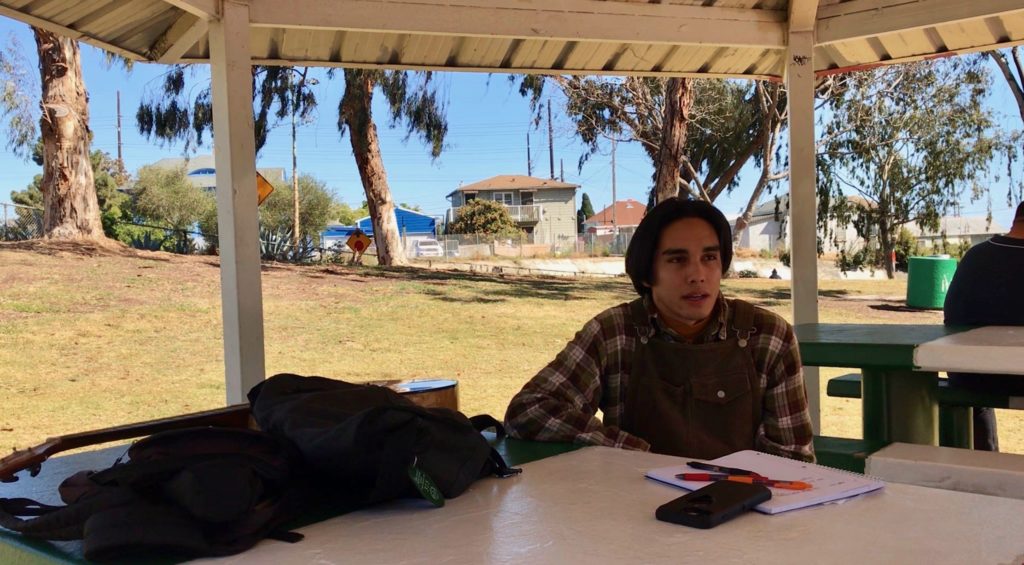
Local promotor and musician Zane Shrem-Besnoy at Liberty Station on March 21.
Photo by Angelica Wallingford

“There needs to be more like 100 capacity rooms,” Shrem-Besnoy explained. “Che Café has a capacity of like 150 which is perfect…it doesn’t feel empty if there’s only 50 people in there and a lot of local bands that’s what they could pull; about 50 people.”

However, the smaller capacity venues are few and far between, which Shrem-Besnoy says is the one of the reasons why bands, artists and producers who currently call San Diego home might pack their instruments and head north to the thriving scene in Los Angeles. 

THE HOMETOWN TRIO

One of the many hometown bands playing the scene and gaining traction is glow!. The trio, made up of San Diego State University Jewish Studies major Sophie Parker, Dagger De La Vergne and Johnny “Blaze” Hurst, have writing together since May 2018.

Before the powerhouse trio became known as glow! around the scene, the members were heavily involved with had other musical projects. Sophia and Dagger met in 2015, started writing music together soon there after and started a band called Trouter Space. However, after De La Vergne moved to Utah for a short period of time, Trouter Space became less active. It wasn’t until he came back summer 2018 and moved in with Sophia that the genesis of glow! began to form.

“I had a lot of songs that were solo songs that I didn’t know what to do with because I really wasn’t doing the Trouter Space thing as much anymore,” De La Vergne said. “When I came out here I was living with her (Sophia) because I didn’t really have a place to stay and we just put all the songs together.”

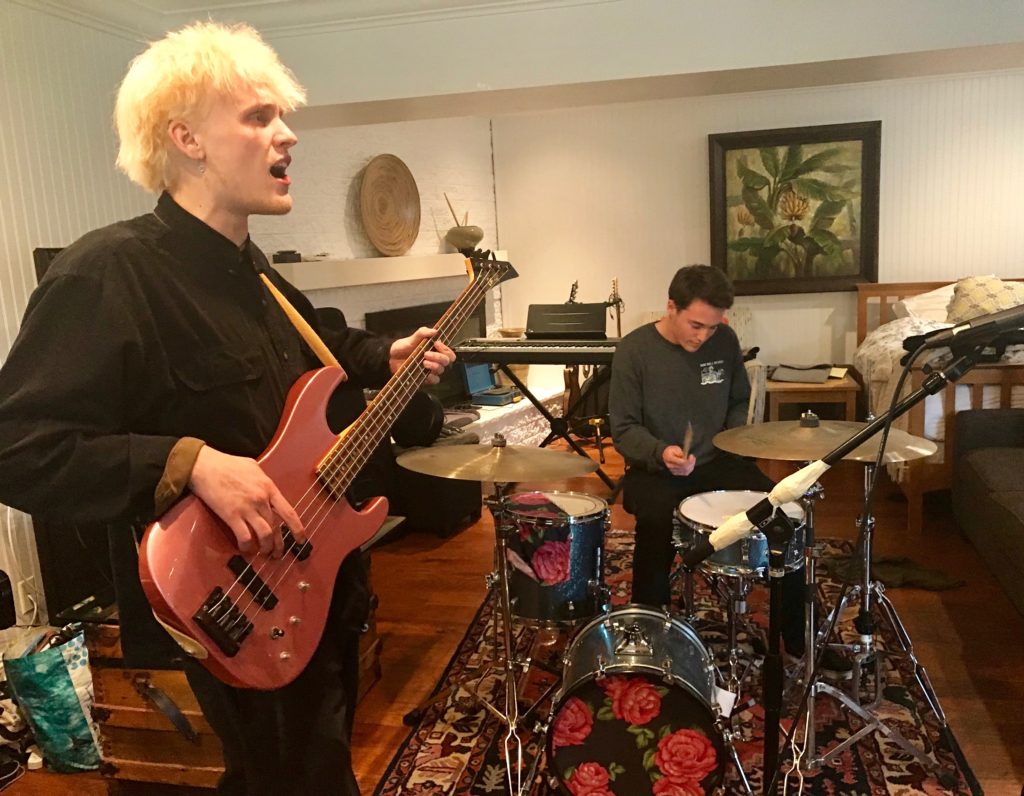
The members of glow!, Dagger De La Vergne, Sophie Parker and Johnny “Blaze” Hurst, respectively rehearse during a session on April 5. Photo by Angelica Wallingford.

The duo was looking for a drummer when De La Vergne met Hurst at a Street Surfers and Foxhide show at local venue Queen Bee’s. Hurst, who has a background playing for other local bands in San Diego, also knew Sophia from high school. With the addition of Hurst, the band has been playing shows since December and consistently writing songs since May 2018.

“We just like clicked and he started playing drums for us and the whole band just came together at that point,” De La Vergne said. “He just added a million times more dynamic…”

In a house atop a hill in La Mesa a residential space is turned into an impromptu rehearsal area. In between the couch and the TV stand sits a drum set. To the right of the front door, chords wind the hardwood floor plugged into the amplifiers and tuners. Next to the amps, lone microphone stand where Parker and De La Vergne will switch lead vocals come practice time.

Amongst the chaos of chords and guitar pedals, Hurst sets up his drum kit placing a shirt as a muffler atop his snare, which he later tosses aside before playing one of the band’s songs. He runs through the percussion part of a song that he was working on before they jump into their first song for the hours long rehearsal.

The band’s experience in the local music scene has been overall a good experience, De La Vergne claims. The problem, he says, lies within the organization of shows and the lack of venues to showcase local artists.

“Collectively, I think there’s a lot of good music that comes from here and I love a lot of the bands that come from here,” De La Vergne said. “At the same time it is pretty messy and inconsistent, not together and not really organized.”

FEW AND FAR BETWEEN

The band points to something that is usually central to a thriving music and arts scene: venues, or in San Diego’s case, a lack thereof.

“If you’re a local band and you’re looking for a venue it’s such an uphill battle,” Shrem-Besnoy said. “There’s just not venues… and I think that’s why the music scene has such a hard time getting legs.”

One of the main problems the members of glow! point out is the seemingly impossible list of requirements that bigger venues have in order for bands to play there. The perspective of bands and artists with smaller followings, the bigger venues tend to focus more on the money the can make from a show rather than just getting the music out there. How many people can the band get to attend and presale tickets are just some of the factors that can make or break a band playing these bigger venues.

One solution that many local groups have come up with to combat the lack of venues is to create their own in the form of house shows. Turning their living space into a functioning venue, holding the capacity crowds that would have otherwise turned up at these smaller venues like the Che Café.

“It’s kind of inhibiting to people like us who are smaller trying to get our name out there, we have all these requirements that we don’t meet for them,” Hurst said. “Everybody is doing house shows because all the venues around here are way to demanding.”

Promoter Héctor Castro, 19, at Chicano Park discussing the San Diego music community on April 18.
Photo by Angelica Wallingford

When the Che Café closed for renovations a few years ago, 19-year-old promoter Héctor Castro didn’t know where he could throw shows that the longtime San Diego establishment once held on a regular basis but also bring together the community that once frequented these shows.

“That really put a roadblock for us because we love to perform, we love to throw shows, we love to have spaces where people can hang out, where we can see our friends,” Castro said. “We didn’t know where to go, so we started throwing house shows.”

While house shows have become a mainstay across San Diego County, it comes with it’s own set of problems. The main being that these DIY shows are located in residential areas and often times can be unorganized, De La Vergne said.   

Kalani Lomu, formerly of longtime San Diego band Bad Kids, has been active in the scene since 2011 and has played in most of the venues scattered throughout San Diego. For Lomu, it’s not the lack of venues that are the problem; it’s the lack of all-ages venues that are the real issue since most bars can double as a performance space.

“The young kids make up a lot of the show goers in the scene and yet there’s like three all ages venues,” Lomu said. “For young bands it’s really not fun being escorted into the venue by the bouncer and then have you kicked to the curb after your set.”

MONEY TALKS

Aside from the lack of venues being an issue for most bands, another issue is the music business in San Diego and the lack of accessibility for people of all backgrounds to participate, according to Castro.

“I live in San Yisidro, I’m not rich, I’m not even in the middle class, I’m not even in the low middle class. I can’t afford to throw $1000 into shows,” Castro said. “It would be amazing to have smaller spaces that can see that and say ‘we have money, we have these promoters that can help you throw these shows and have them happen, we can have spaces that help you have a performance,’ it would be amazing if we had more of that because we don’t.”

The issue of profiting from artists isn’t something particularly new when it comes to music scenes anywhere. The concept of “pay to play” has been used in venues for so long that it’s become almost expected and is something that Shrem-Besnoy disagrees with completely.

Dagger De La Vergne and Johnny “Blaze” Hurst practice during an April 5 session. Photo by Angelica Wallingford

“These people come out to see the bands on the stage,” Shrem-Besnoy said. “They (the bands) deserved to get paid because if it wasn’t for them people wouldn’t be coming to the venue.”

Castro started producing shows when he was 17, at the time he considered it to be a great opportunity because he knew the bands he was booking and the venues to hold the events. At that time, because of his connections, it didn’t cost anything for him to put on an event.

However, with his past two shows he decided to invest about $600 of his own money to create an ambiance for his productions that other venues wouldn’t have otherwise been able to accommodate. Castro took it as a risk because he didn’t know whether he would make a return on his investment and pay out the bands that performed.

“It is kind of a weight on me because I know that if no one shows up, I’m going to have to pay out of my pocket and I end up losing money and hurting me,” Castro said. “It scares me from throwing more shows because I don’t know if its going to be helpful for the community or I’m just going to crumble down and not be able to give more to the community.”

COMMUNITY THROUGH DIVERSITY

For Castro, Shrem-Besnoy, Lomu and the members of glow! the San Diego music scene is more than just a bunch of artists showcasing their work, it’s a community with music just as diverse as the people that make it.

Johnny “Blaze” Hurst and Sophie Parker, members of the local band glow!, rehearse in a converted living space on April 5. Photo by Angelica Wallingford

“One thing about San Diego is that there’s everything here. Going off of bands there’s Beach Goons, they’re like surf rock. You have hardcore bands like frontside… You have things like Sestivity, which is going in a new direction that mixes keyboards and MIDI controlled sounds into their punk music. And then you just have contemporary rock such as Street Surfers, Wizard and all those guys. Then you have rappers, 1207 is huge,” Hurst said. “They’ve made a name for themselves all out of San Diego.”

While San Diego’s music scene might not be as big as the one in Los Angeles, it doesn’t mean that the culture isn’t there and music plays a huge part in that, Lomu claims.

“There’s so much different music coming out of this place it’s honestly hard to keep track of,” Lomu said. “We might not be known as a ‘music city’ but honestly we probably should be.” 

glow! band profile. Filmed and edited exclusively on iPad Pro.
css.php