Unless you’ve been living under a rock for the past year then you should know about Baz Luhrmann’s adaptation of F. Scott Fitzgerald’s classic novel “The Great Gatsby.” The film has been out in theaters for about two weeks and has been getting mixed reviews. The soundtrack, however? I guarantee it’s one of the best film soundtracks you will hear this year.
Development for “The Great Gatsby” had been going on for years. The idea of turning it into a Broadway play had even been tossed around, and in 2008 it was confirmed that Baz Luhrmann would be taking over as director. However, when it came to the soundtrack Luhrmann turned to his go-to composer Craig Armstrong and executive music supervisor Anton Monsted. Jay Z signed on as the co-executive producer and spent two years working with Luhrmann and his team to put out one of the best soundtracks that has been used in a Baz Luhrmann film.
The soundtrack as a whole is amazing. The producers managed to address the themes of decadence, love and excess that are in the story. Musically, the album is all over the place. It’s the music of the roaring 20’s with a modern twist. Elements of hip-hop, rock, electronic dance music; jazz and swing are blended together in a way that doesn’t make it sound cheesy or forced together.
One standout track on the album is “Young and Beautiful” by Lana Del Rey. Her vocals are haunting and emotional. The music has a somber sound to it that matches certain scenes in the film perfectly. Another thing that I liked about this song was that the instrumentation was simple and how the instruments were layered in the song. Overall, this song was a perfect fit for the film and one of the best songs on the soundtrack.
I’ll admit “Young and Beautiful” surprised me because I’m not a big Lana Del Rey fan. I thought that her last two releases were boring and frankly, her whole “daddy, hold me, pale, moonlight, Pepsi cola” thing didn’t really reel me in. However, if her next release is anything like “Young and Beautiful” then she will definitely have a place in my iTunes library.
Another standout track is “Over the Love” by Florence + the Machine. This song was written from the perspective of Daisy Buchanan, Jay Gatsby’s longtime crush. There are also mentions of certain things in the novel like the green light that appears on a dock outside of Daisy’s house and the yellow dress she wears. Musically, this song is a baroque pop ballad with hints of soul, which matches Florence Welch’s voice perfectly. The vocals on this song are powerful and emotional. The lyrics were beautifully written and really capture Daisy’s struggle between Gatsby and her husband, Tom. This song was a hit overall and one of the best songs on the soundtrack.
But of course, with the good always come the bad and this soundtrack only really had one thing that was wrong with it. That thing is the Andre 3000 and Beyoncé cover of Amy Winehouse’s “Back to Black.” This cover is just wrong on almost all levels. It is hands down the worst song on the album and the worst song that Beyoncé has ever been a part of.
“Back to Black” doesn’t need a down tempo EDM wobble, chopped and screwed beats, and weird vocal arrangements. I understand that they wanted this song to be emotional and reimagine it in a unique way but it just did not work in their favor. Instead, they turned one of Amy Winehouse’s best songs into a pile of emotionless EDM crap.
All the producers would have needed to do was slow down the tempo, slightly rearrange the music and let Beyoncé do her thing without Andre 3000. I can almost guarantee that if the producers did that they would have had one of the best songs on the soundtrack and not have the travesty that is on millions of iPods across the country.
All that being said, this was an excellent soundtrack. Baz Luhrmann has an awesome gift of picking out songs that perfectly fit his movies. Just like the songs from his “Romeo + Juliet” and “Moulin Rouge!” soundtracks, the songs on “The Great Gatsby” soundtrack perfectly enhances the story rather than take away from it. If you were to get any soundtrack from the summer movie season, then I highly recommend this one. You won’t be disappointed.
For even more tracks, check out the deluxe version of the soundtrack which includes an orchestral version of “Young and Beautiful,” a remix of “Over the Love” by SBTRKT and dialogue from the film; including one of Tobey Maguire reciting his lines over a brilliant instrumental.
“The Great Gatsby” is in theaters everywhere and the standard and deluxe versions of the soundtrack are available on iTunes.
When most people think of typical Japanese pop music they think of cute outfits and sugary sweet pop songs. At first glance, BABYMETAL fits that description perfectly. Then you put on their debut, self-titled album and boy, are you in for a surprise. The group’s sound is unlike anything you’ve ever heard, in the best possible way.
Not only has BABYMETAL been gaining worldwide recognition through their music videos on YouTube but they have even been featured on the Internet clip show “RightThis Minute” on CNN’s sister network HLN. They are also the youngest group to grace the stage at the world famous Nippon Budokan arena in Tokyo.
BABYMETAL is made up of vocalists Su-metal, Moaetal, Yuimetal – real names Suzuka Nakamoto, Moa Kikuchi and Yui Mizuno respectively — and their supporting band Full Metal Band. The group started off a sub unit of the popular idol group Sakura Gakuin but quickly rose up as one of Japan’s best new artists.
The album is a mixture of varying genres including pop, rock, heavy metal, electronic dance music, industrial and symphonic death metal. On paper there is no way that these genres can work together and have it sound good. BABYMETAL mixes these genres to create a unique genre of their own, called “kawaii metal” or cute metal.
“Megitsune” (translation: female fox or vixen) is undoubtedly the best song on the album. It perfectly captures the aesthetic that is BABYMETAL, a killer mix of high-energy idol pop music and melodic power metal. Lyrically, it’s an analogy between the Japanese folklore that surround women in society today.
“The song relates women and foxes. People think that foxes deceive or disguise. People also think that women wear makeup to disguise themselves and people think ill of foxes as they disguise themselves,” said lead singer Su Metal in an interview on the Japanese TV show “Hot Wave.”
The vocals are another major focal point. It’s not everyday that you find a young vocalist like Su-metal with a strong vocal range. Her vocals combined with Moametal and Yuimetal’s idol vocal style and the growls and screams from the backing band make for an interesting listening experience.
The flow from track to track is seamless. Each song has its own unique sound, changing from genre to genre in an instant giving the listener a whole new experience with each passing song.
Highlights on the album include the cute hip-hop influenced “Ii ne!!,” the dark and heavy intro to the album “BABYMETAL DEATH,” the upbeat synth pop driven “Doki Doki Morning,” the high energy power pop influenced “Headbanger” and the melodic album closer “Ijime, Dame, Zettai.”
BABYMETAL’s self-titled debut is a testament of just how far you take music and experiment with it. Metal is versatile; it isn’t just brutal, hard in-your-face rhythms and melodic guitar riffs. It can be cute, fun and youthful too.
A look behind the curtains of the San Diego music scene
In an unsuspecting corner of a normal street, inside a
normal looking venue is a simple layout — A stage and a small capacity area
for concertgoers. Band after band cross
the stage, setting up their instruments while a sound engineer makes sure they
have the proper levels and sound. Music floods the room and the people, mostly
teenagers and young adults, move to the rhythms that pass through the speakers.
This is the San Diego music scene. Off the beaten path of
bigger and more well known venues like the Observatory, SOMA and the Irenic or
the age 21 and up establishments like Soda Bar and The Casbah. It’s the smaller
capacity venues that house 50 to 100 people and book almost exclusively local
bands that’s the heart of the music scene in America’s Finest City. It’s also
one of the biggest problems plaguing the budding scene, according to Zane
Shrem-Besnoy, a local promoter and musician.
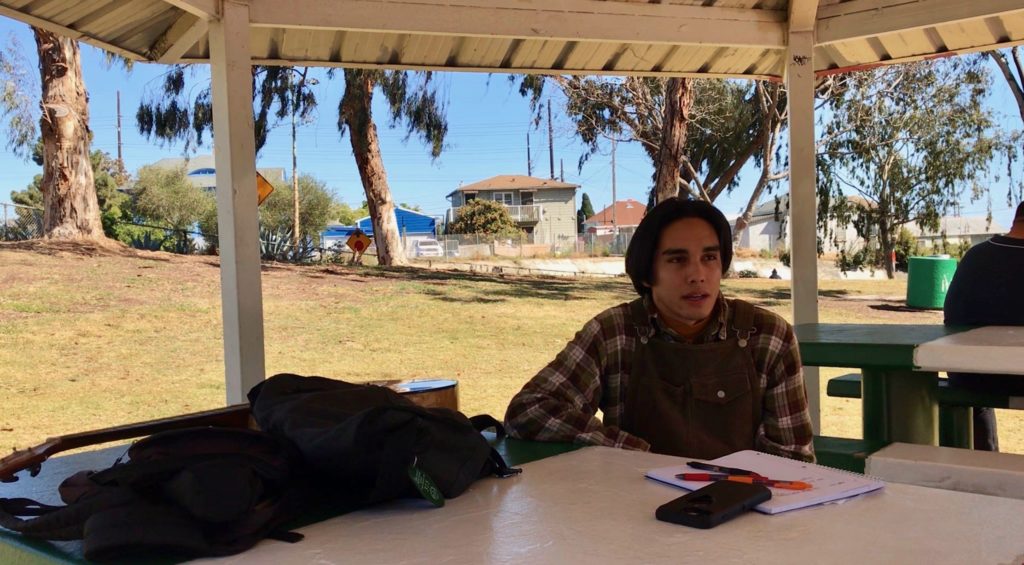
Local promotor and musician Zane Shrem-Besnoy at Liberty Station on March 21. Photo by Angelica Wallingford
“There needs to be more like 100 capacity rooms,”
Shrem-Besnoy explained. “Che Café has a capacity of like 150 which is
perfect…it doesn’t feel empty if there’s only 50 people in there and a lot of
local bands that’s what they could pull; about 50 people.”
However, the smaller capacity venues are few and far
between, which Shrem-Besnoy says is the one of the reasons why bands, artists
and producers who currently call San Diego home might pack their instruments
and head north to the thriving scene in Los Angeles.
THE HOMETOWN TRIO
One of the many hometown bands playing the scene and gaining traction is glow!. The trio, made up of San Diego State University Jewish Studies major Sophie Parker, Dagger De La Vergne and Johnny “Blaze” Hurst, have writing together since May 2018.
Before the powerhouse trio became known as glow! around the scene, the members were heavily involved with had other musical projects. Sophia and Dagger met in 2015, started writing music together soon there after and started a band called Trouter Space. However, after De La Vergne moved to Utah for a short period of time, Trouter Space became less active. It wasn’t until he came back summer 2018 and moved in with Sophia that the genesis of glow! began to form.
“I had a lot of songs that were solo songs that I didn’t
know what to do with because I really wasn’t doing the Trouter Space thing as
much anymore,” De La Vergne said. “When I came out here I was living with her
(Sophia) because I didn’t really have a place to stay and we just put all the
songs together.”
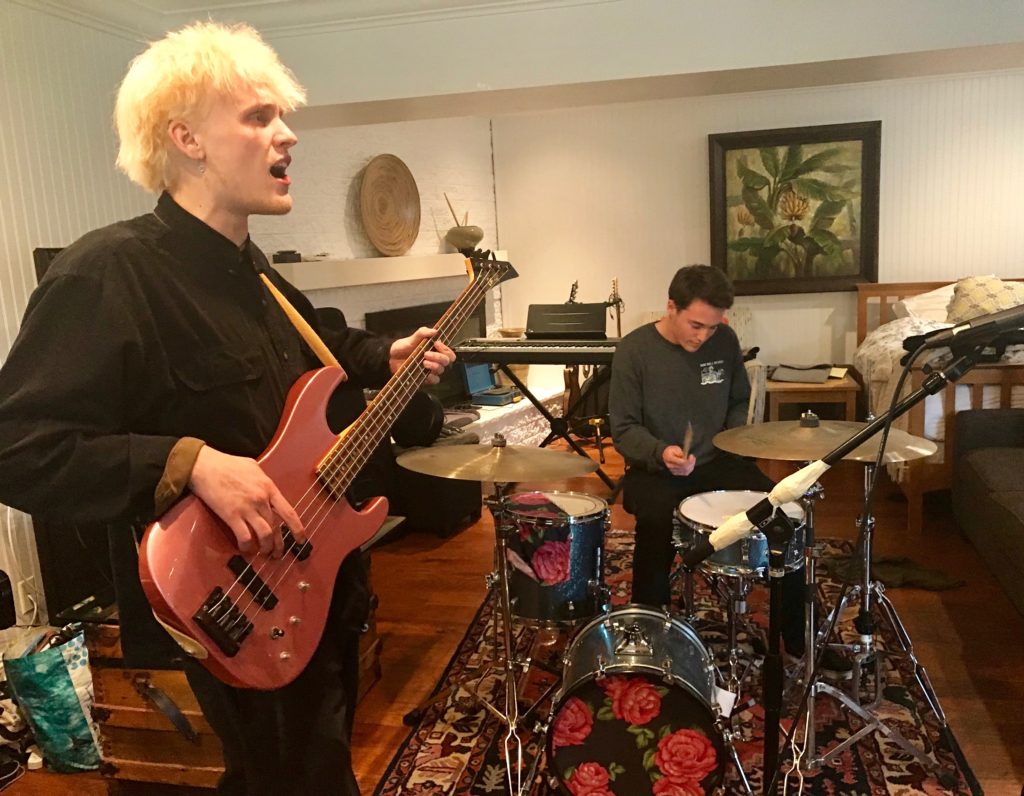
The members of glow!, Dagger De La Vergne, Sophie Parker and Johnny “Blaze” Hurst, respectively rehearse during a session on April 5. Photo by Angelica Wallingford.
The duo was looking for a drummer when De La Vergne met
Hurst at a Street Surfers and Foxhide show at local venue Queen Bee’s. Hurst,
who has a background playing for other local bands in San Diego, also knew
Sophia from high school. With the addition of Hurst, the band has been playing
shows since December and consistently writing songs since May 2018.
“We just like clicked and he started playing drums for us
and the whole band just came together at that point,” De La Vergne said. “He
just added a million times more dynamic…”
In a house atop a hill in La Mesa a residential space is
turned into an impromptu rehearsal area. In between the couch and the TV stand
sits a drum set. To the right of the front door, chords wind the hardwood floor
plugged into the amplifiers and tuners. Next to the amps, lone microphone stand
where Parker and De La Vergne will switch lead vocals come practice time.
Amongst the chaos of chords and guitar pedals, Hurst sets up
his drum kit placing a shirt as a muffler atop his snare, which he later tosses
aside before playing one of the band’s songs. He runs through the percussion
part of a song that he was working on before they jump into their first song
for the hours long rehearsal.
The band’s experience in the local music scene has been
overall a good experience, De La Vergne claims. The problem, he says, lies
within the organization of shows and the lack of venues to showcase local
artists.
“Collectively, I think there’s a lot of good music that
comes from here and I love a lot of the bands that come from here,” De La
Vergne said. “At the same time it is pretty messy and inconsistent, not
together and not really organized.”
FEW AND FAR BETWEEN
The band points to something that is usually central to a thriving music and arts scene: venues, or in San Diego’s case, a lack thereof.
“If you’re a local band and you’re looking for a venue it’s such an uphill battle,” Shrem-Besnoy said. “There’s just not venues… and I think that’s why the music scene has such a hard time getting legs.”
One of the main problems the members of glow! point out is the
seemingly impossible list of requirements that bigger venues have in order for
bands to play there. The perspective of bands and artists with smaller
followings, the bigger venues tend to focus more on the money the can make from
a show rather than just getting the music out there. How many people can the
band get to attend and presale tickets are just some of the factors that can
make or break a band playing these bigger venues.
One solution that many local groups have come up with to
combat the lack of venues is to create their own in the form of house shows.
Turning their living space into a functioning venue, holding the capacity
crowds that would have otherwise turned up at these smaller venues like the Che
Café.
“It’s kind of inhibiting to people like us who are smaller
trying to get our name out there, we have all these requirements that we don’t
meet for them,” Hurst said. “Everybody is doing house shows because all the
venues around here are way to demanding.”
Promoter Héctor Castro, 19, at Chicano Park discussing the San Diego music community on April 18. Photo by Angelica Wallingford
When the Che Café closed for renovations a few years ago,
19-year-old promoter Héctor Castro didn’t know where he could throw shows that
the longtime San Diego establishment once held on a regular basis but also
bring together the community that once frequented these shows.
“That really put a roadblock for us because we love to
perform, we love to throw shows, we love to have spaces where people can hang
out, where we can see our friends,” Castro said. “We didn’t know where to go,
so we started throwing house shows.”
While house shows have become a mainstay across San Diego
County, it comes with it’s own set of problems. The main being that these DIY
shows are located in residential areas and often times can be unorganized, De
La Vergne said.
Kalani Lomu, formerly of longtime San Diego band Bad Kids, has been active in the scene since 2011 and has played in most of the venues scattered throughout San Diego. For Lomu, it’s not the lack of venues that are the problem; it’s the lack of all-ages venues that are the real issue since most bars can double as a performance space.
“The young kids make up a lot of the show goers in the scene and yet there’s like three all ages venues,” Lomu said. “For young bands it’s really not fun being escorted into the venue by the bouncer and then have you kicked to the curb after your set.”
MONEY TALKS
Aside from the lack of venues being an issue for most bands,
another issue is the music business in San Diego and the lack of accessibility
for people of all backgrounds to participate, according to Castro.
“I live in San Yisidro, I’m not rich, I’m not even in the
middle class, I’m not even in the low middle class. I can’t afford to throw
$1000 into shows,” Castro said. “It would be amazing to have smaller spaces
that can see that and say ‘we have money, we have these promoters that can help
you throw these shows and have them happen, we can have spaces that help you
have a performance,’ it would be amazing if we had more of that because we
don’t.”
The issue of profiting from artists isn’t something
particularly new when it comes to music scenes anywhere. The concept of “pay to
play” has been used in venues for so long that it’s become almost expected and
is something that Shrem-Besnoy disagrees with completely.
Dagger De La Vergne and Johnny “Blaze” Hurst practice during an April 5 session. Photo by Angelica Wallingford
“These people come out to see the bands on the stage,”
Shrem-Besnoy said. “They (the bands) deserved to get paid because if it wasn’t
for them people wouldn’t be coming to the venue.”
Castro started producing shows when he was 17, at the time
he considered it to be a great opportunity because he knew the bands he was
booking and the venues to hold the events. At that time, because of his
connections, it didn’t cost anything for him to put on an event.
However, with his past two shows he decided to invest about
$600 of his own money to create an ambiance for his productions that other venues
wouldn’t have otherwise been able to accommodate. Castro took it as a risk
because he didn’t know whether he would make a return on his investment and pay
out the bands that performed.
“It is kind of a weight on me because I know that if no one
shows up, I’m going to have to pay out of my pocket and I end up losing money
and hurting me,” Castro said. “It scares me from throwing more shows because I
don’t know if its going to be helpful for the community or I’m just going to
crumble down and not be able to give more to the community.”
COMMUNITY THROUGH DIVERSITY
For Castro, Shrem-Besnoy, Lomu and the members of glow! the
San Diego music scene is more than just a bunch of artists showcasing their
work, it’s a community with music just as diverse as the people that make it.
Johnny “Blaze” Hurst and Sophie Parker, members of the local band glow!, rehearse in a converted living space on April 5. Photo by Angelica Wallingford
“One thing about San Diego is that there’s everything here.
Going off of bands there’s Beach Goons, they’re like surf rock. You have
hardcore bands like frontside… You have things like Sestivity, which is going
in a new direction that mixes keyboards and MIDI controlled sounds into their
punk music. And then you just have contemporary rock such as Street Surfers,
Wizard and all those guys. Then you have rappers, 1207 is huge,” Hurst said. “They’ve
made a name for themselves all out of San Diego.”
While San Diego’s music scene might not be as big as the one
in Los Angeles, it doesn’t mean that the culture isn’t there and music plays a
huge part in that, Lomu claims.
“There’s so much different music coming out of this place
it’s honestly hard to keep track of,” Lomu said. “We might not be known as a ‘music
city’ but honestly we probably should be.”
glow! band profile. Filmed and edited exclusively on iPad Pro.