Grammy-winning musician Bill Yeager leads SDSU jazz studies through experience

The generic phrase “be prepared for anything” is often met with a sigh and eye roll from those who hear it. In the case of San Diego State’s Director of Jazz Studies Bill Yeager, it’s the advice he credits for his success as an award-winning musician and a lifelong educator.

Yeager started at SDSU in 1985 after founding and running the Los Angeles Jazz Workshop for 10 years. In just a few short years, he accepted a full-time position and has led the jazz studies program to be one of the most prestigious in the country, including an upcoming trip to Montenegro for Jazz Appreciation Week slated for next semester.

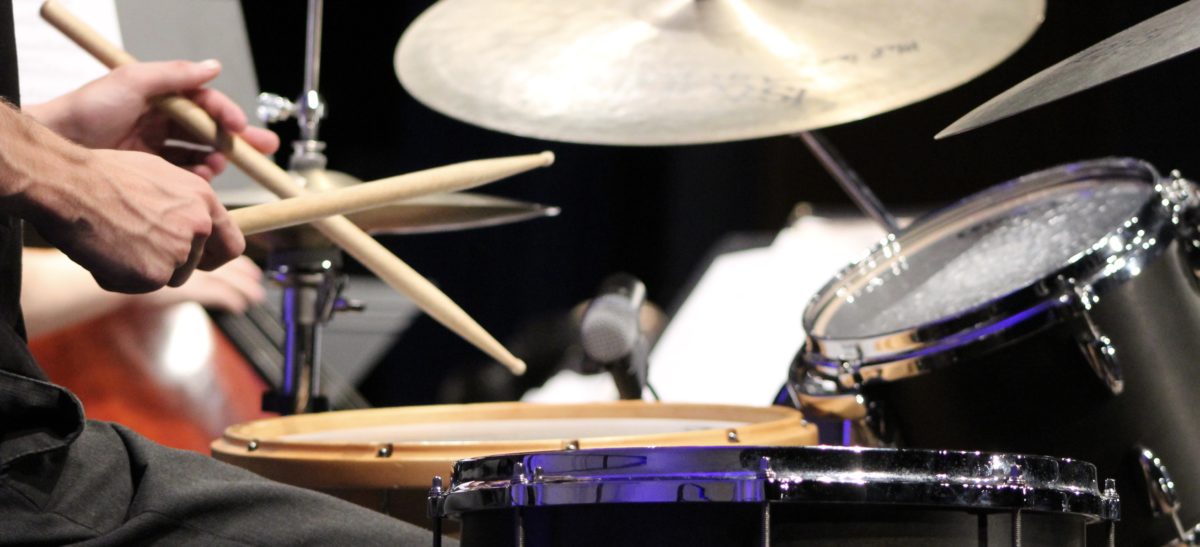
Justin Joyce, an SDSU graduate student and drummer in the jazz ensemble led by Yeager, cites his passion as a driving force behind his students succeeding in the field.

“His constant desire for his students’ success is very apparent,” Joyce said.  “There (are) too many ways he’s influenced my life, but every one of them ultimately has improved my sense of awareness, work ethic and enjoyment of life and how music is one of life’s necessities.”

Yeager’s journey to becoming SDSU’s director of jazz studies wasn’t a rocky road filled with bumps and dips; but rather, a winding path of unexpected twists and turns.

“My advice to you is to be prepared for any and all opportunities that are offered to you in life,” Yeager said at SDSU’s 2017 Professional Studies and Fine Arts commencement ceremony. “You don’t always end up doing exactly what you think you will be doing for your life’s work.”

His resume reads like that of a seasoned studio musician rather than an educator. The lifelong trombonist has played in bands for Tony Bennett, Frank Sinatra and Ella Fitzgerald, and has been featured on recordings for Ray Charles, various organizations and record companies. He’s also received multiple Grammy nominations, including a win for a record he did with Charles.

Yeager, 66, says it all started in elementary school when he had to pick out an instrument to learn. He started out wanting to play drums as his first choice and the trumpet as his second, but a savvy sales associate convinced him otherwise.

“I think the guy at the music store wanted to sell a trombone and he said that my lips were too big for the trumpet, which, of course, is absurd,” he said. “It was this guy who’s just trying to see a certain product, but that’s how I picked trombone.”

His love of jazz, however, didn’t come until high school. Yeager was a natural at playing classical music, but  jazz became an obstacle for him. His high school band director would play him jazz records and have him pay close attention to their characteristics.

“Jazz has come hard for me,” Yeager said. “It was something that I had to really work at. Maybe that’s why I think I’m a good teacher in the jazz area, because I had to really work on it. It didn’t come as natural to me as playing sonatas and concertos.”

After getting acquainted with his new instrument, Yeager took to music like a fish takes to water. According to him, it was music that helped him go from a straight-C student to getting A’s throughout his academic career and creating a positive chance that has stayed with him all his life.

“I got C’s in everything except music and physical education,” Yeager recalls. “Music gave me self-confidence where I didn’t have any.”

Upon graduating high school in 1970, Yeager enrolled in the University of North Texas, which, at the time, had the largest music department and the most prestigious jazz program in the country. He completed his bachelor’s degree in ’74 and his masters of music in ’76, with an emphasis on performance and a minor in conducting and jazz.

While still an undergrad, he started getting jobs in recording studios in Dallas, which at the time was known as the “jingle capital,” Yeager said.

“The studios were run by alumni of the University of Texas, and that’s how I got my foot in the door,” he said. “I’d travel 30 minutes to and from Denton to Dallas for sessions, it helped me tremendously as a musician.”

Prior to founding the Los Angeles Jazz Workshop in ’79, Yeager became the director of instrumental music at Grove School of Music, founded by jazz pianist Dick Grove, whom he was introduced to when Grove did a clinic at the University of Texas. He received the job while playing in a night band conducted by Alf Clausen, best known for his composition work on “The Simpsons.”

“(Clausen) was getting so busy that he didn’t really have time to conduct that band anymore,” Yeager said. “So, Dick (Grove) came to me and said, ‘We’d like you to be the director of the band.’”

Eventually, being the conductor of a jazz band was only one of a multitude of responsibilities he had at the Grove School. Yeager became the conductor of two other bands, founded the Professional Instrumental Music Program and became an instructor.

However, two years into his time at the Grove School, he and Grove had a major disagreement involving repertoire that led them to part ways.

“He would have 30 people write a television excerpt based on, let’s say, ‘Frère Jacques,’ and so, here are my guys paying money to be in this band and they would come to a rehearsal and we’d play 30 versions of ‘Frère Jacques,’” Yeager recalled. “And it was like, you know it’s not fair. That’s not what they came here for. So, we basically had a parting of the ways, and I knew I was right.”

Yeager founded the Los Angeles Jazz Workshop in 1979 so jazz musicians could have the opportunity to showcase their skills rather than play “30 different” TV jingles. In a remarkable move, all 30 musicians from the Grove School moved to Yeager’s rival institution which helped his new endeavor start off with a bang.

Before he knew it, Yeager’s workshop grew at an exponential rate to include instruction in composition and arranging, led by some of the best musicians in Los Angeles.

“I had a complete full band, the very first day,” he said. “And then that grew into two bands, then three. Eventually I had five full 18-piece big bands. That essence of having that number one Grove band 100 percent leave and come with me made it to where I could pay the rent.”

In the meantime, Yeager took up piloting a small plane that once belonged to a dear friend in Los Angeles who suffered a stroke and could not fly alone. During his final years at the Los Angeles Jazz Workshop, he was hired as an instructor at SDSU, commuting back and forth from Los Angeles to San Diego in his Cessna 172 airplane before securing his tenure and settling in Cardiff-By-The-Sea.

“I have become very attached to my SDSU students and totally committed to San Diego State University,” Yeager said in the commencement speech. “The SDSU Jazz Studies program has flourished into becoming one of the best in the country.”

Yeager’s last statement rings true. He has led the Jazz Studies program to a multitude of awards and numerous performances with great jazz musicians such as pianist Matt Hall and students from his Los Angeles Jazz Workshop and Grove School days.

After knowing him for the past six years, Joyce looks back fondly about how Yeager has gone the extra mile, providing more than just instruction to his students.

“To be honest, I’ve never really thought of him as a professor, he has always shown more guidance and advice to just be considered a professor,” Joyce said.  “He’ll tell you directly what you need to hear to help you succeed as a professional.”

Yeager has no plans on retiring just yet. He says he wants “at least another five years” at SDSU. After some reflecting, he harkens back to a modified version of his old saying that he told the 2017 PSFA graduating class: “Be prepared for anything, because nobody knows what can happen.”

Originally published in the Daily Aztec in October 2018.

SDSU Jazz Ensemble honors late alumnus who left behind $750,000 endowment

The San Diego State Jazz Ensemble dedicated its Nov. 7 concert to late alumnus Pitt Warner after it was announced in late October that the longtime jazz musician left a $750,000 endowment to the Jazz Studies program at the School of Music and Dance.

The Pitt and Virginia Warner Jazz Studies Endowment will support the Jazz Studies program and its students by providing funds that include scholarships, travel, equipment, conference and musical festival attendance, music commissions, music purchases, guests artists and clinicians, according to Director of Jazz Studies Bill Yeager.

Warner, who died in 2016, was a renowned jazz drummer who not only played on SDSU’s jazz ensemble for many years, but also performed with many other bands, including local Latin jazz group The Bordermen.

Jazz ensemble drummer and SDSU graduate student Justin Joyce became acquainted with Warner through the Jazz Studies program and said he said he thinks that Warner’s gift was an amazing contribution to the music department because of massive funding cuts that arts programs have taken in recent years.

“The music departments are folding, like all the way ,going down to elementary school and it resonates coming up to the top too,” Joyce said. “I mean, it’s like (the business college) would get something like $3 million and us, we’ll get like $28,000… So it’s a great thing that he left it to us.”

Warner also left behind equipment for jazz students, including two complete drum sets and multi-track recording equipment worth over $100,000, Yeager said.

“He left so much gear for us, and , as a drummer, I’m very thankful, but as a musician I’m even more thankful,” Joyce said. “He was a great guy, a great musician.”

Music entrepreneurship and business freshman Derrick Kennedy Martin Jr. said he thinks that the endowment will give great opportunities for music students, especially when it comes to the possibility of traveling and experiencing different musical styles and cultures.

“It provides us with opportunities that we wouldn’t otherwise be able to have as jazz students,” Martin Jr. said. “(The endowment) has the potential to provide us with different countries to be able to play with where you get different styles of music and styles of people and it’s just a great cultural experience from all types of musicians and people.”

Along with Warner’s endowment, the Jazz Studies also has Eugene and Barbara Bowman Endowment Fund, worth $150,000, which was awarded to the department two years ago.

The endowment was Warner’s second gift to the university. After his wife Virginia, an SDSU alumna with a degree in English, died in 2012 he gave a donation for the Pitt and Virginia Warner Suite in the Department of English and Comparative Literature.

Originally published in The Daily Aztec in November 2017.

‘Great Gatsby’ soundtrack brings a modern twist to the 1920’s

Unless you’ve been living under a rock for the past year then you should know about Baz Luhrmann’s adaptation of F. Scott Fitzgerald’s classic novel “The Great Gatsby.” The film has been out in theaters for about two weeks and has been getting mixed reviews. The soundtrack, however? I guarantee it’s one of the best film soundtracks you will hear this year.

Development for “The Great Gatsby” had been going on for years. The idea of turning it into a Broadway play had even been tossed around, and in 2008 it was confirmed that Baz Luhrmann would be taking over as director. However, when it came to the soundtrack Luhrmann turned to his go-to composer Craig Armstrong and executive music supervisor Anton Monsted. Jay Z signed on as the co-executive producer and spent two years working with Luhrmann and his team to put out one of the best soundtracks that has been used in a Baz Luhrmann film.

The soundtrack as a whole is amazing. The producers managed to address the themes of decadence, love and excess that are in the story. Musically, the album is all over the place. It’s the music of the roaring 20’s with a modern twist. Elements of hip-hop, rock, electronic dance music; jazz and swing are blended together in a way that doesn’t make it sound cheesy or forced together.

One standout track on the album is “Young and Beautiful” by Lana Del Rey. Her vocals are haunting and emotional. The music has a somber sound to it that matches certain scenes in the film perfectly. Another thing that I liked about this song was that the instrumentation was simple and how the instruments were layered in the song. Overall, this song was a perfect fit for the film and one of the best songs on the soundtrack.

I’ll admit “Young and Beautiful” surprised me because I’m not a big Lana Del Rey fan. I thought that her last two releases were boring and frankly, her whole “daddy, hold me, pale, moonlight, Pepsi cola” thing didn’t really reel me in. However, if her next release is anything like “Young and Beautiful” then she will definitely have a place in my iTunes library.

Another standout track is “Over the Love” by Florence + the Machine. This song was written from the perspective of Daisy Buchanan, Jay Gatsby’s longtime crush. There are also mentions of certain things in the novel like the green light that appears on a dock outside of Daisy’s house and the yellow dress she wears. Musically, this song is a baroque pop ballad with hints of soul, which matches Florence Welch’s voice perfectly. The vocals on this song are powerful and emotional. The lyrics were beautifully written and really capture Daisy’s struggle between Gatsby and her husband, Tom. This song was a hit overall and one of the best songs on the soundtrack.

But of course, with the good always come the bad and this soundtrack only really had one thing that was wrong with it. That thing is the Andre 3000 and Beyoncé cover of Amy Winehouse’s “Back to Black.” This cover is just wrong on almost all levels. It is hands down the worst song on the album and the worst song that Beyoncé has ever been a part of.

“Back to Black” doesn’t need a down tempo EDM wobble, chopped and screwed beats, and weird vocal arrangements. I understand that they wanted this song to be emotional and reimagine it in a unique way but it just did not work in their favor. Instead, they turned one of Amy Winehouse’s best songs into a pile of emotionless EDM crap.

All the producers would have needed to do was slow down the tempo, slightly rearrange the music and let Beyoncé do her thing without Andre 3000. I can almost guarantee that if the producers did that they would have had one of the best songs on the soundtrack and not have the travesty that is on millions of iPods across the country.

All that being said, this was an excellent soundtrack. Baz Luhrmann has an awesome gift of picking out songs that perfectly fit his movies. Just like the songs from his “Romeo + Juliet” and “Moulin Rouge!” soundtracks, the songs on “The Great Gatsby” soundtrack perfectly enhances the story rather than take away from it. If you were to get any soundtrack from the summer movie season, then I highly recommend this one. You won’t be disappointed.

For even more tracks, check out the deluxe version of the soundtrack which includes an orchestral version of “Young and Beautiful,” a remix of “Over the Love” by SBTRKT and dialogue from the film; including one of Tobey Maguire reciting his lines over a brilliant instrumental.

“The Great Gatsby” is in theaters everywhere and the standard and deluxe versions of the soundtrack are available on iTunes.

Originally published in City Times, May 2013.

Justin Timberlake’s ’20/20 Experience’: Not worth the seven-year wait

After seven long years away from the music industry Justin Timberlake decided it was time to hang up his actors’ hat, slip on a tuxedo and get back in the studio with his longtime collaborators and some new ones, to give us his long awaited new album. Sounds like a recipe for an amazing album right? Well, think again.

In early 2013 Timberlake hinted at a comeback on his Twitter account by releasing a tweet that said “I think I’M READY,” along with a link to a YouTube video of him walking into a studio explaining why he hasn’t released anything in so long. In the video he said that he didn’t want to release anything that he doesn’t love. After months of recording, “The 20/20 Experience” was finally released on March 18. For his newest album, Timberlake took on the role of executive producer and head songwriter.

The main problem I have with the album is that some of the music tracks sounds like a complete rehash of Timbaland’s other work. At times it could feel like your listening to “FutureSex/LoveSounds” or “Shock Value II” rather then Timberlake’s newest release. On top of that, some of the songs, like “Spaceship Coupe,” easily sound like they could be a Robin Thicke song.

Then there are the lyrics. Timberlake is a pretty good songwriter that is responsible for some of the catchiest hooks in pop music. However, some of the lyrics are corny and border on literary porn. The most blatant use of these types of lyrics is the song “Strawberry Bubblegum,” which appears to be a metaphor of some kind for a woman’s vagina. In the song, Timberlake sings the lines “your mouth emotion gets me so high” and “we’re making love like professionals.” Wait a minute: professionals? What does that even mean? No passion with a contractual agreement? No one would want to be apart of that, no matter who was singing it.

Another thing that I didn’t initially like was that most of the songs are extended mixes that are seven to eight minutes long. The perfect example of this is the opening track “Pusher Love Girl.” That song could have ended at the 4-minute fifty-four second mark and be a really strong opener but then the song goes into this remix like breakdown. This however, is a very minor flaw that listeners will get use to after listening to the album a lot.

All those cons being said, this is actually a decent album. It’s not Timberlake’s best release, but it’s far from his worst. The one thing that I absolutely love about this album is that it’s not a straightforward pop album. As soon as I heard of his comeback I thought he was going for a pop sound, like many people did. I was wrong and this was one instance where I’m glad I was. There are influences from all across the musical spectrum. The mixture of old school ‘60s R&B;, ‘70s funk, neo-soul, hip-hop, jazz, pop and much more make this album worth listening to. The album stays away from any of the cliché dubstep bass lines and other EDM musical styles, which is a nice change up since that seems to be the norm for pop artists today. There are also a lot of artistic influences on the album as well, such as Prince, Quincy Jones, and Michael Jackson. The flow on this album is another thing that I liked. It makes going from one track to another almost seamless, even with the typical four-second gap time. His voice is also a major plus. Each song compliments his tenor voice almost perfectly, which makes for pretty sweet ear candy.

Highlights include the first single “Suit & Tie,” the high energy Timbaland produced “Tunnel Vision,” the raw soulful throwback “That Girl,” the Latin influenced track “Let the Groove In,” the minimalist track “Blue Ocean Floor,” and the sweet shout out to his wife “Mirrors.” The worst track on the album has to be “Don’t Hold the Wall.”

Even with its flaws “The 20/20 Experience” has a more mature and grown-up sound then Timberlake’s previous releases, manages to stay true to his artistic aesthetic and makes for an interesting listening experience that his longtime fans will love.

“The 20/20 Experience” is available in stores and on iTunes.

Originally published in City Times, April 2013.

css.php