Students dig archaeology professor

It began as a childhood experience cracking open shale on the side of a mountain in Monterey that started a lifelong love affair with history.

“I was mesmerized that evidence of the past could be found hidden in the ground around us,” Seth Mallios, longtime San Diego State anthropology and archaeology professor said. “That delight has never left me and led me to the fields of archaeology, anthropology and history.”

His students, who cite his immense passion for uncovering things and his interesting perspective on the past, see him as an inspirational figure. Amethyst Sanchez, an anthropology and sociology major, credits him and their many chats to changing her perspective and giving her the drive to achieve her goals.

“Without him, I probably would only have minored in anthropology, which is now the field I want to spend my life working in,” Sanchez said. “I would have missed out on so many incredible opportunities to do actual anthropological work before even earning my degree.”

Long before he called SDSU his home, Mallios’ career as an anthropologist started in Virginia, where he taught the introductory anthropology and the Jamestown Field School in Historical Archaeology courses at the University of Alabama. After his move to San Diego, he noticed the stark contrast between the ways regional history was looked at between the two cities.

“I also know that seeing different areas of the country where, in some places, the past is revered and you would never think of developing over a cemetery,” Mallios said. “You can’t go into a grocery store without someone telling you that they are a descendant of John Smith or Pocahontas and then coming out here and it being just the opposite.”

His first major project in San Diego was a gravestone project where he discovered many of the graveyards were intentionally paved over for freeways, buildings and roads.

“I wasn’t expecting too many surprises and the joke was on me because 75 percent of San Diego’s cemeteries have been developed over and I had just come from Jamestown,” Mallios said. “Everybody there is so into talking about the past, thinking about the past.”

In the classroom, Mallios’ passion for history is passed on to his students. One of his fundamental teaching philosophies is that students need hands on experience in the field to really understand what excavating is like in the real world, compared to the glamorized version of it that appears on TV.

“Dr. Mallios lets the students go through every process of a dig,” Shannon Farnsworth, an anthropology and history major, said. “We measured the units, we dug the dirt, we screened the dirt, we mapped the walls of our unit, we filled out the paperwork, we took soil samples and we were able to experience a real dig.”

Recently Mallios was named official university curator, a title he takes just as serious as his studies or excavations.

“It is rewarding to see the university formally acknowledge the importance of its own history and culture,” he said. “I believe that these distinctive aspects should be celebrated and preserved, and this position allows me to do that.”

Jamie Lennox, an associate professor of anthropology and one of Mallios’ former students, is the current interim director of SDSU’s collections management program and has assisted him with numerous projects over the years.

One of the major projects was co-authoring the five-volume book set titled “Let It Rock!” which was a retrospective of all the live events hosted at SDSU.

“It’s a very meticulous process – you cast a wide net and literally go through everything very slowly and carefully,” Lennox said. “You take copious amounts of notes, as you frequently will need to revisit something or retrace your steps.”

Together with Lennox, Mallios has preserved artifacts from SDSU’s colorful past including multiple WPA mementos such as benches, plaques and murals — some of which are preserved in the campus library.

“These clues to an earlier time when the campus was much smaller, when there was no city around it,” Mallios said. “That gets to a deeper understanding of not only San Diego State’s place in the community, but the hundreds of thousands of people that experienced it here on campus.”

Mallios sees SDSU’s history as more of a grey area than just black and white. He cites well known places on campus like Hepner Hall as examples of how buildings that have been seen as divisive have underlying meanings like the Muslim influence on the construction of SDSU’s iconic hall.

“I never knew about the history of SDSU,” Farnsworth said. “In class we read his book ‘Hail Montezuma’ and then went on a scavenger hunt to some of the historical places on campus. It makes me really proud to go here and I feel more connected to the school and my fellow classmates.”

Mallios’ current passion project is working on a book on the history of Nate Harrison, San Diego’s first permanent African American resident and frontiersman. He brought four of his students with him to excavate on Palomar Mountain during spring break to uncover new artifacts about Harrison and explore San Diego’s history back when it was known as the “Selma of the south.”

He hopes his book will be slated for release at the end of 2019.  

After all these years, Mallios says he still gets the same feeling when he discovers something new – the same one he feels when uncovering new things at the Nate Harrison site and the gravestones he explored when he first moved to San Diego.  

“There is the thrill of finding something that has been lost or forgotten,” Mallios said. “The contentment of seeing how this missing piece helps make sense of the chaos of today’s world.”

Originally published in the Daily Aztec in April 2018.

Grammy-winning musician Bill Yeager leads SDSU jazz studies through experience

The generic phrase “be prepared for anything” is often met with a sigh and eye roll from those who hear it. In the case of San Diego State’s Director of Jazz Studies Bill Yeager, it’s the advice he credits for his success as an award-winning musician and a lifelong educator.

Yeager started at SDSU in 1985 after founding and running the Los Angeles Jazz Workshop for 10 years. In just a few short years, he accepted a full-time position and has led the jazz studies program to be one of the most prestigious in the country, including an upcoming trip to Montenegro for Jazz Appreciation Week slated for next semester.

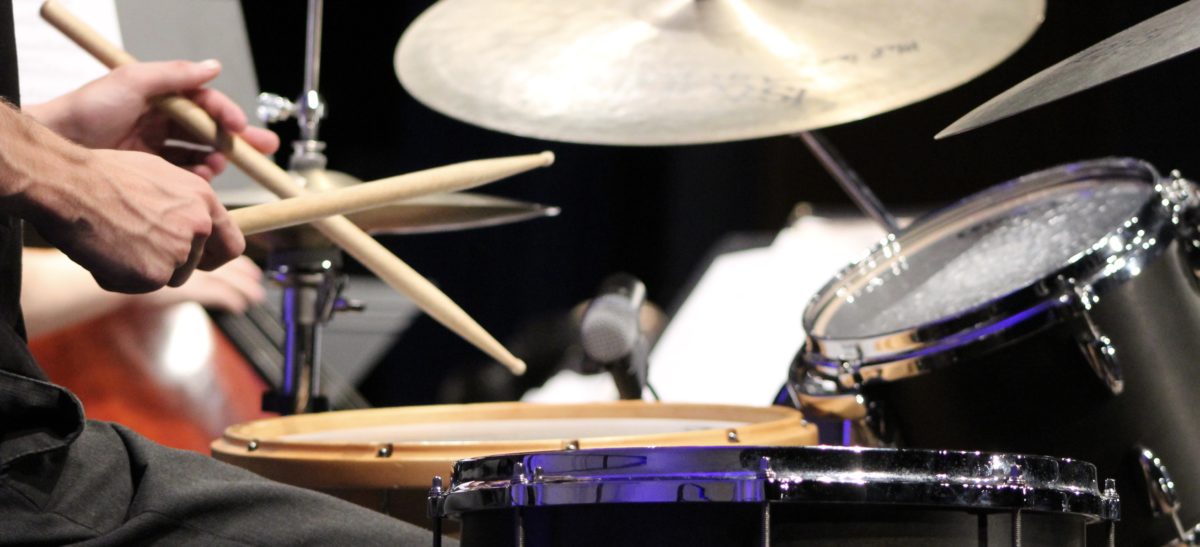
Justin Joyce, an SDSU graduate student and drummer in the jazz ensemble led by Yeager, cites his passion as a driving force behind his students succeeding in the field.

“His constant desire for his students’ success is very apparent,” Joyce said.  “There (are) too many ways he’s influenced my life, but every one of them ultimately has improved my sense of awareness, work ethic and enjoyment of life and how music is one of life’s necessities.”

Yeager’s journey to becoming SDSU’s director of jazz studies wasn’t a rocky road filled with bumps and dips; but rather, a winding path of unexpected twists and turns.

“My advice to you is to be prepared for any and all opportunities that are offered to you in life,” Yeager said at SDSU’s 2017 Professional Studies and Fine Arts commencement ceremony. “You don’t always end up doing exactly what you think you will be doing for your life’s work.”

His resume reads like that of a seasoned studio musician rather than an educator. The lifelong trombonist has played in bands for Tony Bennett, Frank Sinatra and Ella Fitzgerald, and has been featured on recordings for Ray Charles, various organizations and record companies. He’s also received multiple Grammy nominations, including a win for a record he did with Charles.

Yeager, 66, says it all started in elementary school when he had to pick out an instrument to learn. He started out wanting to play drums as his first choice and the trumpet as his second, but a savvy sales associate convinced him otherwise.

“I think the guy at the music store wanted to sell a trombone and he said that my lips were too big for the trumpet, which, of course, is absurd,” he said. “It was this guy who’s just trying to see a certain product, but that’s how I picked trombone.”

His love of jazz, however, didn’t come until high school. Yeager was a natural at playing classical music, but  jazz became an obstacle for him. His high school band director would play him jazz records and have him pay close attention to their characteristics.

“Jazz has come hard for me,” Yeager said. “It was something that I had to really work at. Maybe that’s why I think I’m a good teacher in the jazz area, because I had to really work on it. It didn’t come as natural to me as playing sonatas and concertos.”

After getting acquainted with his new instrument, Yeager took to music like a fish takes to water. According to him, it was music that helped him go from a straight-C student to getting A’s throughout his academic career and creating a positive chance that has stayed with him all his life.

“I got C’s in everything except music and physical education,” Yeager recalls. “Music gave me self-confidence where I didn’t have any.”

Upon graduating high school in 1970, Yeager enrolled in the University of North Texas, which, at the time, had the largest music department and the most prestigious jazz program in the country. He completed his bachelor’s degree in ’74 and his masters of music in ’76, with an emphasis on performance and a minor in conducting and jazz.

While still an undergrad, he started getting jobs in recording studios in Dallas, which at the time was known as the “jingle capital,” Yeager said.

“The studios were run by alumni of the University of Texas, and that’s how I got my foot in the door,” he said. “I’d travel 30 minutes to and from Denton to Dallas for sessions, it helped me tremendously as a musician.”

Prior to founding the Los Angeles Jazz Workshop in ’79, Yeager became the director of instrumental music at Grove School of Music, founded by jazz pianist Dick Grove, whom he was introduced to when Grove did a clinic at the University of Texas. He received the job while playing in a night band conducted by Alf Clausen, best known for his composition work on “The Simpsons.”

“(Clausen) was getting so busy that he didn’t really have time to conduct that band anymore,” Yeager said. “So, Dick (Grove) came to me and said, ‘We’d like you to be the director of the band.’”

Eventually, being the conductor of a jazz band was only one of a multitude of responsibilities he had at the Grove School. Yeager became the conductor of two other bands, founded the Professional Instrumental Music Program and became an instructor.

However, two years into his time at the Grove School, he and Grove had a major disagreement involving repertoire that led them to part ways.

“He would have 30 people write a television excerpt based on, let’s say, ‘Frère Jacques,’ and so, here are my guys paying money to be in this band and they would come to a rehearsal and we’d play 30 versions of ‘Frère Jacques,’” Yeager recalled. “And it was like, you know it’s not fair. That’s not what they came here for. So, we basically had a parting of the ways, and I knew I was right.”

Yeager founded the Los Angeles Jazz Workshop in 1979 so jazz musicians could have the opportunity to showcase their skills rather than play “30 different” TV jingles. In a remarkable move, all 30 musicians from the Grove School moved to Yeager’s rival institution which helped his new endeavor start off with a bang.

Before he knew it, Yeager’s workshop grew at an exponential rate to include instruction in composition and arranging, led by some of the best musicians in Los Angeles.

“I had a complete full band, the very first day,” he said. “And then that grew into two bands, then three. Eventually I had five full 18-piece big bands. That essence of having that number one Grove band 100 percent leave and come with me made it to where I could pay the rent.”

In the meantime, Yeager took up piloting a small plane that once belonged to a dear friend in Los Angeles who suffered a stroke and could not fly alone. During his final years at the Los Angeles Jazz Workshop, he was hired as an instructor at SDSU, commuting back and forth from Los Angeles to San Diego in his Cessna 172 airplane before securing his tenure and settling in Cardiff-By-The-Sea.

“I have become very attached to my SDSU students and totally committed to San Diego State University,” Yeager said in the commencement speech. “The SDSU Jazz Studies program has flourished into becoming one of the best in the country.”

Yeager’s last statement rings true. He has led the Jazz Studies program to a multitude of awards and numerous performances with great jazz musicians such as pianist Matt Hall and students from his Los Angeles Jazz Workshop and Grove School days.

After knowing him for the past six years, Joyce looks back fondly about how Yeager has gone the extra mile, providing more than just instruction to his students.

“To be honest, I’ve never really thought of him as a professor, he has always shown more guidance and advice to just be considered a professor,” Joyce said.  “He’ll tell you directly what you need to hear to help you succeed as a professional.”

Yeager has no plans on retiring just yet. He says he wants “at least another five years” at SDSU. After some reflecting, he harkens back to a modified version of his old saying that he told the 2017 PSFA graduating class: “Be prepared for anything, because nobody knows what can happen.”

Originally published in the Daily Aztec in October 2018.

Schools in PSFA announce new directors

Two schools in the College of Professional Studies and Fine Arts will have new directors for the fall 2018 semester.

Charles Friedrichs and J.D. Hopkins, the current directors of the School of Music and Dance, and the School of Theatre, Television, and Film, will be stepping down from their positions at the end of the semester. The announcement for the director position was announced in November 2017, according to Eric Smigel, a music professor and search committee chair.

Candidates for the director position for both schools will tour the campus throughout March, while final candidate for the School of Theatre, Television and Film is scheduled after spring break.

“The process just takes a while and a faculty position has to be set aside, the dean has her concerns,” Friedrichs said. “She sets aside then they get a committee and they do the advertising and now they are in the process of bringing somebody… for interviews.”

Friedrichs decided to retire a year and a half ago after 42 years of teaching, with the last five of those as the acting director. For Hopkins, his decision to leave the director position at the School of Theatre, Television and Film was due to a strong internal pull towards his loves of teaching and research.

“I’ve had a great experience running the school and working with my colleagues,” Hopkins said. “I think we’ve came out of the recession over the last six years and moved into a really strong position in a lot of measurable ways.”

Hopkins also serves on the hiring committee for the director position of the School of Music and Dance. He said it was decided by PSFA Dean Joyce Gattas that the directors wouldn’t be involved in hiring for their own position, a policy she’s held for a long time.

“There was some discussion on whether or not there would be looking for an internal candidate or doing a national search, and it quickly moved to the direction of national search,” Hopkins said.

Of the roughly 60 applicants for the director position for the School of Music and Dance, Scott Lipscomb from the College Conservatory of Music at the University of Cincinnati, John Sposato from the University of Houston and Elizabeth Cooper from the University of Hartford were chosen for on-campus interviews.

The candidates for the School of Theatre, Television and Film are Niyi Coker Jr. from the University of Missouri-St. Louis, Andrew Shea from the University of Texas-Austin and Ann Archbold from the University of Wisconsin-Madison.

“The Dean will make her decision after that (visit) and offers will go out. I wouldn’t venture to speculate on the timeline after that point,” Hopkins said. “We intend to have decisions made by the end of the semester.”

Even with changes to leadership, Director of Jazz Studies Bill Yeager feels optimistic about the future of the School of Music and Dance.

“We have the very best instructors available in all areas and an amazing amount of student talent,” Yeager said.  This high level of teaching, combined with outstanding students, ensures a bright future.”

Firedrichs’ last day is acting director will be May 31 while Hopkins is slated to stay on until June. The new directors’ contracts will begin on July 1.

Originally published in the Daily Aztec in April 2018.

css.php