The generic phrase “be prepared for anything” is often met with a sigh and eye roll from those who hear it. In the case of San Diego State’s Director of Jazz Studies Bill Yeager, it’s the advice he credits for his success as an award-winning musician and a lifelong educator.
Yeager started at SDSU in 1985 after founding and running the Los Angeles Jazz Workshop for 10 years. In just a few short years, he accepted a full-time position and has led the jazz studies program to be one of the most prestigious in the country, including an upcoming trip to Montenegro for Jazz Appreciation Week slated for next semester.
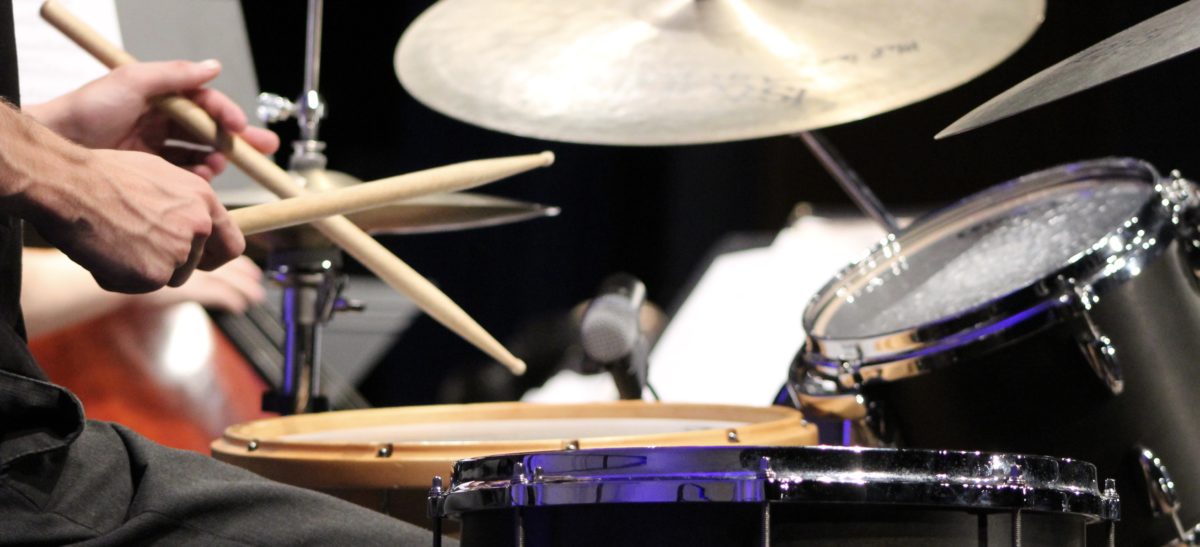
Justin Joyce, an SDSU graduate student and drummer in the jazz ensemble led by Yeager, cites his passion as a driving force behind his students succeeding in the field.
“His constant desire for his students’ success is very apparent,” Joyce said. “There (are) too many ways he’s influenced my life, but every one of them ultimately has improved my sense of awareness, work ethic and enjoyment of life and how music is one of life’s necessities.”
Yeager’s journey to becoming SDSU’s director of jazz studies wasn’t a rocky road filled with bumps and dips; but rather, a winding path of unexpected twists and turns.
“My advice to you is to be prepared for any and all opportunities that are offered to you in life,” Yeager said at SDSU’s 2017 Professional Studies and Fine Arts commencement ceremony. “You don’t always end up doing exactly what you think you will be doing for your life’s work.”
His resume reads like that of a seasoned studio musician rather than an educator. The lifelong trombonist has played in bands for Tony Bennett, Frank Sinatra and Ella Fitzgerald, and has been featured on recordings for Ray Charles, various organizations and record companies. He’s also received multiple Grammy nominations, including a win for a record he did with Charles.
Yeager, 66, says it all started in elementary school when he had to pick out an instrument to learn. He started out wanting to play drums as his first choice and the trumpet as his second, but a savvy sales associate convinced him otherwise.
“I think the guy at the music store wanted to sell a trombone and he said that my lips were too big for the trumpet, which, of course, is absurd,” he said. “It was this guy who’s just trying to see a certain product, but that’s how I picked trombone.”
His love of jazz, however, didn’t come until high school. Yeager was a natural at playing classical music, but jazz became an obstacle for him. His high school band director would play him jazz records and have him pay close attention to their characteristics.
“Jazz has come hard for me,” Yeager said. “It was something that I had to really work at. Maybe that’s why I think I’m a good teacher in the jazz area, because I had to really work on it. It didn’t come as natural to me as playing sonatas and concertos.”
After getting acquainted with his new instrument, Yeager took to music like a fish takes to water. According to him, it was music that helped him go from a straight-C student to getting A’s throughout his academic career and creating a positive chance that has stayed with him all his life.
“I got C’s in everything except music and physical education,” Yeager recalls. “Music gave me self-confidence where I didn’t have any.”
Upon graduating high school in 1970, Yeager enrolled in the University of North Texas, which, at the time, had the largest music department and the most prestigious jazz program in the country. He completed his bachelor’s degree in ’74 and his masters of music in ’76, with an emphasis on performance and a minor in conducting and jazz.
While still an undergrad, he started getting jobs in recording studios in Dallas, which at the time was known as the “jingle capital,” Yeager said.
“The studios were run by alumni of the University of Texas, and that’s how I got my foot in the door,” he said. “I’d travel 30 minutes to and from Denton to Dallas for sessions, it helped me tremendously as a musician.”
Prior to founding the Los Angeles Jazz Workshop in ’79, Yeager became the director of instrumental music at Grove School of Music, founded by jazz pianist Dick Grove, whom he was introduced to when Grove did a clinic at the University of Texas. He received the job while playing in a night band conducted by Alf Clausen, best known for his composition work on “The Simpsons.”
“(Clausen) was getting so busy that he didn’t really have time to conduct that band anymore,” Yeager said. “So, Dick (Grove) came to me and said, ‘We’d like you to be the director of the band.’”
Eventually, being the conductor of a jazz band was only one of a multitude of responsibilities he had at the Grove School. Yeager became the conductor of two other bands, founded the Professional Instrumental Music Program and became an instructor.
However, two years into his time at the Grove School, he and Grove had a major disagreement involving repertoire that led them to part ways.
“He would have 30 people write a television excerpt based on, let’s say, ‘Frère Jacques,’ and so, here are my guys paying money to be in this band and they would come to a rehearsal and we’d play 30 versions of ‘Frère Jacques,’” Yeager recalled. “And it was like, you know it’s not fair. That’s not what they came here for. So, we basically had a parting of the ways, and I knew I was right.”
Yeager founded the Los Angeles Jazz Workshop in 1979 so jazz musicians could have the opportunity to showcase their skills rather than play “30 different” TV jingles. In a remarkable move, all 30 musicians from the Grove School moved to Yeager’s rival institution which helped his new endeavor start off with a bang.
Before he knew it, Yeager’s workshop grew at an exponential rate to include instruction in composition and arranging, led by some of the best musicians in Los Angeles.
“I had a complete full band, the very first day,” he said. “And then that grew into two bands, then three. Eventually I had five full 18-piece big bands. That essence of having that number one Grove band 100 percent leave and come with me made it to where I could pay the rent.”
In the meantime, Yeager took up piloting a small plane that once belonged to a dear friend in Los Angeles who suffered a stroke and could not fly alone. During his final years at the Los Angeles Jazz Workshop, he was hired as an instructor at SDSU, commuting back and forth from Los Angeles to San Diego in his Cessna 172 airplane before securing his tenure and settling in Cardiff-By-The-Sea.
“I have become very attached to my SDSU students and totally committed to San Diego State University,” Yeager said in the commencement speech. “The SDSU Jazz Studies program has flourished into becoming one of the best in the country.”
Yeager’s last statement rings true. He has led the Jazz Studies program to a multitude of awards and numerous performances with great jazz musicians such as pianist Matt Hall and students from his Los Angeles Jazz Workshop and Grove School days.
After knowing him for the past six years, Joyce looks back fondly about how Yeager has gone the extra mile, providing more than just instruction to his students.
“To be honest, I’ve never really thought of him as a professor, he has always shown more guidance and advice to just be considered a professor,” Joyce said. “He’ll tell you directly what you need to hear to help you succeed as a professional.”
Yeager has no plans on retiring just yet. He says he wants “at least another five years” at SDSU. After some reflecting, he harkens back to a modified version of his old saying that he told the 2017 PSFA graduating class: “Be prepared for anything, because nobody knows what can happen.”
Originally published in the Daily Aztec in October 2018.
