Grammy-winning musician Bill Yeager leads SDSU jazz studies through experience

The generic phrase “be prepared for anything” is often met with a sigh and eye roll from those who hear it. In the case of San Diego State’s Director of Jazz Studies Bill Yeager, it’s the advice he credits for his success as an award-winning musician and a lifelong educator.

Yeager started at SDSU in 1985 after founding and running the Los Angeles Jazz Workshop for 10 years. In just a few short years, he accepted a full-time position and has led the jazz studies program to be one of the most prestigious in the country, including an upcoming trip to Montenegro for Jazz Appreciation Week slated for next semester.

Justin Joyce, an SDSU graduate student and drummer in the jazz ensemble led by Yeager, cites his passion as a driving force behind his students succeeding in the field.

“His constant desire for his students’ success is very apparent,” Joyce said.  “There (are) too many ways he’s influenced my life, but every one of them ultimately has improved my sense of awareness, work ethic and enjoyment of life and how music is one of life’s necessities.”

Yeager’s journey to becoming SDSU’s director of jazz studies wasn’t a rocky road filled with bumps and dips; but rather, a winding path of unexpected twists and turns.

“My advice to you is to be prepared for any and all opportunities that are offered to you in life,” Yeager said at SDSU’s 2017 Professional Studies and Fine Arts commencement ceremony. “You don’t always end up doing exactly what you think you will be doing for your life’s work.”

His resume reads like that of a seasoned studio musician rather than an educator. The lifelong trombonist has played in bands for Tony Bennett, Frank Sinatra and Ella Fitzgerald, and has been featured on recordings for Ray Charles, various organizations and record companies. He’s also received multiple Grammy nominations, including a win for a record he did with Charles.

Yeager, 66, says it all started in elementary school when he had to pick out an instrument to learn. He started out wanting to play drums as his first choice and the trumpet as his second, but a savvy sales associate convinced him otherwise.

“I think the guy at the music store wanted to sell a trombone and he said that my lips were too big for the trumpet, which, of course, is absurd,” he said. “It was this guy who’s just trying to see a certain product, but that’s how I picked trombone.”

His love of jazz, however, didn’t come until high school. Yeager was a natural at playing classical music, but  jazz became an obstacle for him. His high school band director would play him jazz records and have him pay close attention to their characteristics.

“Jazz has come hard for me,” Yeager said. “It was something that I had to really work at. Maybe that’s why I think I’m a good teacher in the jazz area, because I had to really work on it. It didn’t come as natural to me as playing sonatas and concertos.”

After getting acquainted with his new instrument, Yeager took to music like a fish takes to water. According to him, it was music that helped him go from a straight-C student to getting A’s throughout his academic career and creating a positive chance that has stayed with him all his life.

“I got C’s in everything except music and physical education,” Yeager recalls. “Music gave me self-confidence where I didn’t have any.”

Upon graduating high school in 1970, Yeager enrolled in the University of North Texas, which, at the time, had the largest music department and the most prestigious jazz program in the country. He completed his bachelor’s degree in ’74 and his masters of music in ’76, with an emphasis on performance and a minor in conducting and jazz.

While still an undergrad, he started getting jobs in recording studios in Dallas, which at the time was known as the “jingle capital,” Yeager said.

“The studios were run by alumni of the University of Texas, and that’s how I got my foot in the door,” he said. “I’d travel 30 minutes to and from Denton to Dallas for sessions, it helped me tremendously as a musician.”

Prior to founding the Los Angeles Jazz Workshop in ’79, Yeager became the director of instrumental music at Grove School of Music, founded by jazz pianist Dick Grove, whom he was introduced to when Grove did a clinic at the University of Texas. He received the job while playing in a night band conducted by Alf Clausen, best known for his composition work on “The Simpsons.”

“(Clausen) was getting so busy that he didn’t really have time to conduct that band anymore,” Yeager said. “So, Dick (Grove) came to me and said, ‘We’d like you to be the director of the band.’”

Eventually, being the conductor of a jazz band was only one of a multitude of responsibilities he had at the Grove School. Yeager became the conductor of two other bands, founded the Professional Instrumental Music Program and became an instructor.

However, two years into his time at the Grove School, he and Grove had a major disagreement involving repertoire that led them to part ways.

“He would have 30 people write a television excerpt based on, let’s say, ‘Frère Jacques,’ and so, here are my guys paying money to be in this band and they would come to a rehearsal and we’d play 30 versions of ‘Frère Jacques,’” Yeager recalled. “And it was like, you know it’s not fair. That’s not what they came here for. So, we basically had a parting of the ways, and I knew I was right.”

Yeager founded the Los Angeles Jazz Workshop in 1979 so jazz musicians could have the opportunity to showcase their skills rather than play “30 different” TV jingles. In a remarkable move, all 30 musicians from the Grove School moved to Yeager’s rival institution which helped his new endeavor start off with a bang.

Before he knew it, Yeager’s workshop grew at an exponential rate to include instruction in composition and arranging, led by some of the best musicians in Los Angeles.

“I had a complete full band, the very first day,” he said. “And then that grew into two bands, then three. Eventually I had five full 18-piece big bands. That essence of having that number one Grove band 100 percent leave and come with me made it to where I could pay the rent.”

In the meantime, Yeager took up piloting a small plane that once belonged to a dear friend in Los Angeles who suffered a stroke and could not fly alone. During his final years at the Los Angeles Jazz Workshop, he was hired as an instructor at SDSU, commuting back and forth from Los Angeles to San Diego in his Cessna 172 airplane before securing his tenure and settling in Cardiff-By-The-Sea.

“I have become very attached to my SDSU students and totally committed to San Diego State University,” Yeager said in the commencement speech. “The SDSU Jazz Studies program has flourished into becoming one of the best in the country.”

Yeager’s last statement rings true. He has led the Jazz Studies program to a multitude of awards and numerous performances with great jazz musicians such as pianist Matt Hall and students from his Los Angeles Jazz Workshop and Grove School days.

After knowing him for the past six years, Joyce looks back fondly about how Yeager has gone the extra mile, providing more than just instruction to his students.

“To be honest, I’ve never really thought of him as a professor, he has always shown more guidance and advice to just be considered a professor,” Joyce said.  “He’ll tell you directly what you need to hear to help you succeed as a professional.”

Yeager has no plans on retiring just yet. He says he wants “at least another five years” at SDSU. After some reflecting, he harkens back to a modified version of his old saying that he told the 2017 PSFA graduating class: “Be prepared for anything, because nobody knows what can happen.”

Originally published in the Daily Aztec in October 2018.

SDSU Jazz Ensemble honors late alumnus who left behind $750,000 endowment

The San Diego State Jazz Ensemble dedicated its Nov. 7 concert to late alumnus Pitt Warner after it was announced in late October that the longtime jazz musician left a $750,000 endowment to the Jazz Studies program at the School of Music and Dance.

The Pitt and Virginia Warner Jazz Studies Endowment will support the Jazz Studies program and its students by providing funds that include scholarships, travel, equipment, conference and musical festival attendance, music commissions, music purchases, guests artists and clinicians, according to Director of Jazz Studies Bill Yeager.

Warner, who died in 2016, was a renowned jazz drummer who not only played on SDSU’s jazz ensemble for many years, but also performed with many other bands, including local Latin jazz group The Bordermen.

Jazz ensemble drummer and SDSU graduate student Justin Joyce became acquainted with Warner through the Jazz Studies program and said he said he thinks that Warner’s gift was an amazing contribution to the music department because of massive funding cuts that arts programs have taken in recent years.

“The music departments are folding, like all the way ,going down to elementary school and it resonates coming up to the top too,” Joyce said. “I mean, it’s like (the business college) would get something like $3 million and us, we’ll get like $28,000… So it’s a great thing that he left it to us.”

Warner also left behind equipment for jazz students, including two complete drum sets and multi-track recording equipment worth over $100,000, Yeager said.

“He left so much gear for us, and , as a drummer, I’m very thankful, but as a musician I’m even more thankful,” Joyce said. “He was a great guy, a great musician.”

Music entrepreneurship and business freshman Derrick Kennedy Martin Jr. said he thinks that the endowment will give great opportunities for music students, especially when it comes to the possibility of traveling and experiencing different musical styles and cultures.

“It provides us with opportunities that we wouldn’t otherwise be able to have as jazz students,” Martin Jr. said. “(The endowment) has the potential to provide us with different countries to be able to play with where you get different styles of music and styles of people and it’s just a great cultural experience from all types of musicians and people.”

Along with Warner’s endowment, the Jazz Studies also has Eugene and Barbara Bowman Endowment Fund, worth $150,000, which was awarded to the department two years ago.

The endowment was Warner’s second gift to the university. After his wife Virginia, an SDSU alumna with a degree in English, died in 2012 he gave a donation for the Pitt and Virginia Warner Suite in the Department of English and Comparative Literature.

Originally published in The Daily Aztec in November 2017.

The 1975’s debut album is what pop music should be

After 11 years and four EPs, The 1975 finally released their long awaited self-titled debut album and it was worth every second of the wait.

The 1975 have been gaining rapid momentum since the release of their first EP “Facedown” in August 2012. Three other EP releases quickly followed titled “Sex,” “Music for Cars” and “IV” respectively. The EPs, while amazing in their own right, provided somewhat of a warning for what their debut album would be like: loud, eclectic and unlike anything you’ve ever heard.

The music on the album is all over the place, jumping from atmospheric experimental tracks like “Talk!” to more straightforward pop tracks like “Girls.” This is all thanks to the bands self-identified “lack of identity.”

Lack of identity has often led to really bad albums but in this case however, it works beautifully. It’s obvious that the band has listened to a lot of music over their 11-years together and that they have learned from it.

Then there are songs like the mellow “Menswear” and the stripped down “Is There Somebody That Can Watch You” that serve as nice breaks from the in your face alt-pop music that permeates through the entire album.

Lyrically, the album could be the poster child for youthful angst. The band provides a witty and catchy commentary that deals with topics such as sex, drugs, love and experimentation. This album touches on so many levels of young adulthood that it could easily have been the soundtrack to your formative years.

The flaws in this album, while albeit minor, are still there. The only thing I didn’t really like was that in “Talk!” the guitar sounds looped and the bass almost gets completely drowned out by the drums during the verses.

All in all, The 1975 have proven that their debut album not only transcends genres but also proves to be that breath of fresh air that music today needs. These are the kind of songs that deserve to be played on the radio and obtain the number one spot on top of the charts.

Other artists should take note because this is what a pop album should be. It should pay homage to the genres that influenced the band but at the same time should stay true to their own style and identity, or lack thereof, in The 1975’s case.

Highlights include the re-recording of the song “Sex,” the two previous EP singles “Chocolate” and “This City,” the intricate and vocally hypnotizing “Robbers,” the experimental “Heart Out” and the two most straightforward pop songs “Settle Down” and “Girls.”

The 1975’s debut album is out now and available on iTunes.

Originally published in City Times, September 2013.

‘Great Gatsby’ soundtrack brings a modern twist to the 1920’s

Unless you’ve been living under a rock for the past year then you should know about Baz Luhrmann’s adaptation of F. Scott Fitzgerald’s classic novel “The Great Gatsby.” The film has been out in theaters for about two weeks and has been getting mixed reviews. The soundtrack, however? I guarantee it’s one of the best film soundtracks you will hear this year.

Development for “The Great Gatsby” had been going on for years. The idea of turning it into a Broadway play had even been tossed around, and in 2008 it was confirmed that Baz Luhrmann would be taking over as director. However, when it came to the soundtrack Luhrmann turned to his go-to composer Craig Armstrong and executive music supervisor Anton Monsted. Jay Z signed on as the co-executive producer and spent two years working with Luhrmann and his team to put out one of the best soundtracks that has been used in a Baz Luhrmann film.

The soundtrack as a whole is amazing. The producers managed to address the themes of decadence, love and excess that are in the story. Musically, the album is all over the place. It’s the music of the roaring 20’s with a modern twist. Elements of hip-hop, rock, electronic dance music; jazz and swing are blended together in a way that doesn’t make it sound cheesy or forced together.

One standout track on the album is “Young and Beautiful” by Lana Del Rey. Her vocals are haunting and emotional. The music has a somber sound to it that matches certain scenes in the film perfectly. Another thing that I liked about this song was that the instrumentation was simple and how the instruments were layered in the song. Overall, this song was a perfect fit for the film and one of the best songs on the soundtrack.

I’ll admit “Young and Beautiful” surprised me because I’m not a big Lana Del Rey fan. I thought that her last two releases were boring and frankly, her whole “daddy, hold me, pale, moonlight, Pepsi cola” thing didn’t really reel me in. However, if her next release is anything like “Young and Beautiful” then she will definitely have a place in my iTunes library.

Another standout track is “Over the Love” by Florence + the Machine. This song was written from the perspective of Daisy Buchanan, Jay Gatsby’s longtime crush. There are also mentions of certain things in the novel like the green light that appears on a dock outside of Daisy’s house and the yellow dress she wears. Musically, this song is a baroque pop ballad with hints of soul, which matches Florence Welch’s voice perfectly. The vocals on this song are powerful and emotional. The lyrics were beautifully written and really capture Daisy’s struggle between Gatsby and her husband, Tom. This song was a hit overall and one of the best songs on the soundtrack.

But of course, with the good always come the bad and this soundtrack only really had one thing that was wrong with it. That thing is the Andre 3000 and Beyoncé cover of Amy Winehouse’s “Back to Black.” This cover is just wrong on almost all levels. It is hands down the worst song on the album and the worst song that Beyoncé has ever been a part of.

“Back to Black” doesn’t need a down tempo EDM wobble, chopped and screwed beats, and weird vocal arrangements. I understand that they wanted this song to be emotional and reimagine it in a unique way but it just did not work in their favor. Instead, they turned one of Amy Winehouse’s best songs into a pile of emotionless EDM crap.

All the producers would have needed to do was slow down the tempo, slightly rearrange the music and let Beyoncé do her thing without Andre 3000. I can almost guarantee that if the producers did that they would have had one of the best songs on the soundtrack and not have the travesty that is on millions of iPods across the country.

All that being said, this was an excellent soundtrack. Baz Luhrmann has an awesome gift of picking out songs that perfectly fit his movies. Just like the songs from his “Romeo + Juliet” and “Moulin Rouge!” soundtracks, the songs on “The Great Gatsby” soundtrack perfectly enhances the story rather than take away from it. If you were to get any soundtrack from the summer movie season, then I highly recommend this one. You won’t be disappointed.

For even more tracks, check out the deluxe version of the soundtrack which includes an orchestral version of “Young and Beautiful,” a remix of “Over the Love” by SBTRKT and dialogue from the film; including one of Tobey Maguire reciting his lines over a brilliant instrumental.

“The Great Gatsby” is in theaters everywhere and the standard and deluxe versions of the soundtrack are available on iTunes.

Originally published in City Times, May 2013.

‘Kawaii’ metal goes viral

When most people think of typical Japanese pop music they think of cute outfits and sugary sweet pop songs. At first glance, BABYMETAL fits that description perfectly. Then you put on their debut, self-titled album and boy, are you in for a surprise. The group’s sound is unlike anything you’ve ever heard, in the best possible way.

Not only has BABYMETAL been gaining worldwide recognition through their music videos on YouTube but they have even been featured on the Internet clip show “RightThis Minute” on CNN’s sister network HLN. They are also the youngest group to grace the stage at the world famous Nippon Budokan arena in Tokyo.

BABYMETAL is made up of vocalists Su-metal, Moaetal, Yuimetal – real names Suzuka Nakamoto, Moa Kikuchi and Yui Mizuno respectively — and their supporting band Full Metal Band. The group started off a sub unit of the popular idol group Sakura Gakuin but quickly rose up as one of Japan’s best new artists.

The album is a mixture of varying genres including pop, rock, heavy metal, electronic dance music, industrial and symphonic death metal. On paper there is no way that these genres can work together and have it sound good. BABYMETAL mixes these genres to create a unique genre of their own, called “kawaii metal” or cute metal.

“Megitsune” (translation: female fox or vixen) is undoubtedly the best song on the album. It perfectly captures the aesthetic that is BABYMETAL, a killer mix of high-energy idol pop music and melodic power metal. Lyrically, it’s an analogy between the Japanese folklore that surround women in society today.

“The song relates women and foxes. People think that foxes deceive or disguise. People also think that women wear makeup to disguise themselves and people think ill of foxes as they disguise themselves,” said lead singer Su Metal in an interview on the Japanese TV show “Hot Wave.”

The vocals are another major focal point. It’s not everyday that you find a young vocalist like Su-metal with a strong vocal range. Her vocals combined with Moametal and Yuimetal’s idol vocal style and the growls and screams from the backing band make for an interesting listening experience.

The flow from track to track is seamless. Each song has its own unique sound, changing from genre to genre in an instant giving the listener a whole new experience with each passing song.

Highlights on the album include the cute hip-hop influenced “Ii ne!!,” the dark and heavy intro to the album “BABYMETAL DEATH,” the upbeat synth pop driven “Doki Doki Morning,” the high energy power pop influenced “Headbanger” and the melodic album closer “Ijime, Dame, Zettai.”

BABYMETAL’s self-titled debut is a testament of just how far you take music and experiment with it. Metal is versatile; it isn’t just brutal, hard in-your-face rhythms and melodic guitar riffs. It can be cute, fun and youthful too.

Originally published in City Times, March 2014.

A Scene like no other

A look behind the curtains of the San Diego music scene

In an unsuspecting corner of a normal street, inside a normal looking venue is a simple layout — A stage and a small capacity area for concertgoers.  Band after band cross the stage, setting up their instruments while a sound engineer makes sure they have the proper levels and sound. Music floods the room and the people, mostly teenagers and young adults, move to the rhythms that pass through the speakers.

This is the San Diego music scene. Off the beaten path of bigger and more well known venues like the Observatory, SOMA and the Irenic or the age 21 and up establishments like Soda Bar and The Casbah. It’s the smaller capacity venues that house 50 to 100 people and book almost exclusively local bands that’s the heart of the music scene in America’s Finest City. It’s also one of the biggest problems plaguing the budding scene, according to Zane Shrem-Besnoy, a local promoter and musician.

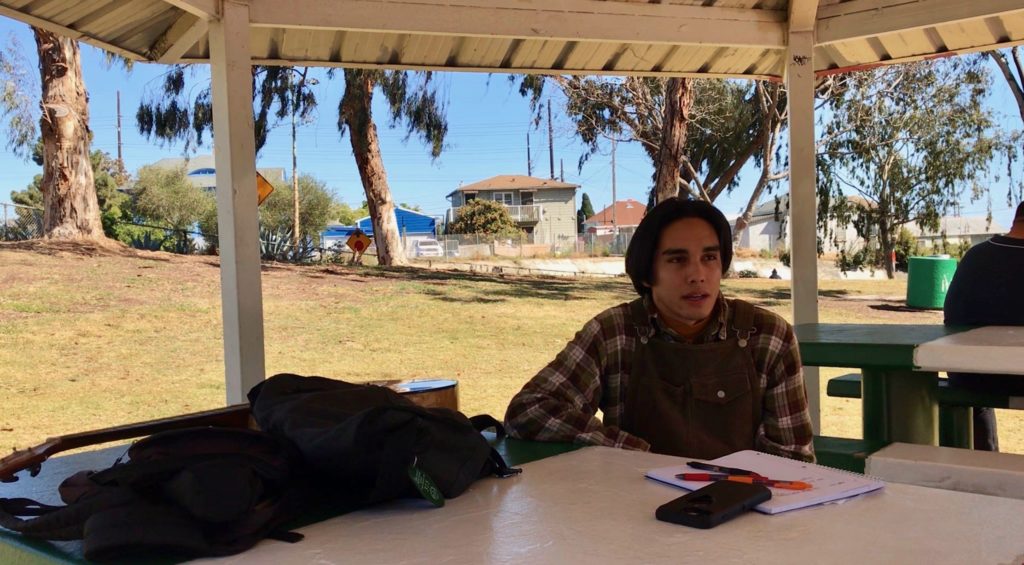
Local promotor and musician Zane Shrem-Besnoy at Liberty Station on March 21.
Photo by Angelica Wallingford

“There needs to be more like 100 capacity rooms,” Shrem-Besnoy explained. “Che Café has a capacity of like 150 which is perfect…it doesn’t feel empty if there’s only 50 people in there and a lot of local bands that’s what they could pull; about 50 people.”

However, the smaller capacity venues are few and far between, which Shrem-Besnoy says is the one of the reasons why bands, artists and producers who currently call San Diego home might pack their instruments and head north to the thriving scene in Los Angeles. 

THE HOMETOWN TRIO

One of the many hometown bands playing the scene and gaining traction is glow!. The trio, made up of San Diego State University Jewish Studies major Sophie Parker, Dagger De La Vergne and Johnny “Blaze” Hurst, have writing together since May 2018.

Before the powerhouse trio became known as glow! around the scene, the members were heavily involved with had other musical projects. Sophia and Dagger met in 2015, started writing music together soon there after and started a band called Trouter Space. However, after De La Vergne moved to Utah for a short period of time, Trouter Space became less active. It wasn’t until he came back summer 2018 and moved in with Sophia that the genesis of glow! began to form.

“I had a lot of songs that were solo songs that I didn’t know what to do with because I really wasn’t doing the Trouter Space thing as much anymore,” De La Vergne said. “When I came out here I was living with her (Sophia) because I didn’t really have a place to stay and we just put all the songs together.”

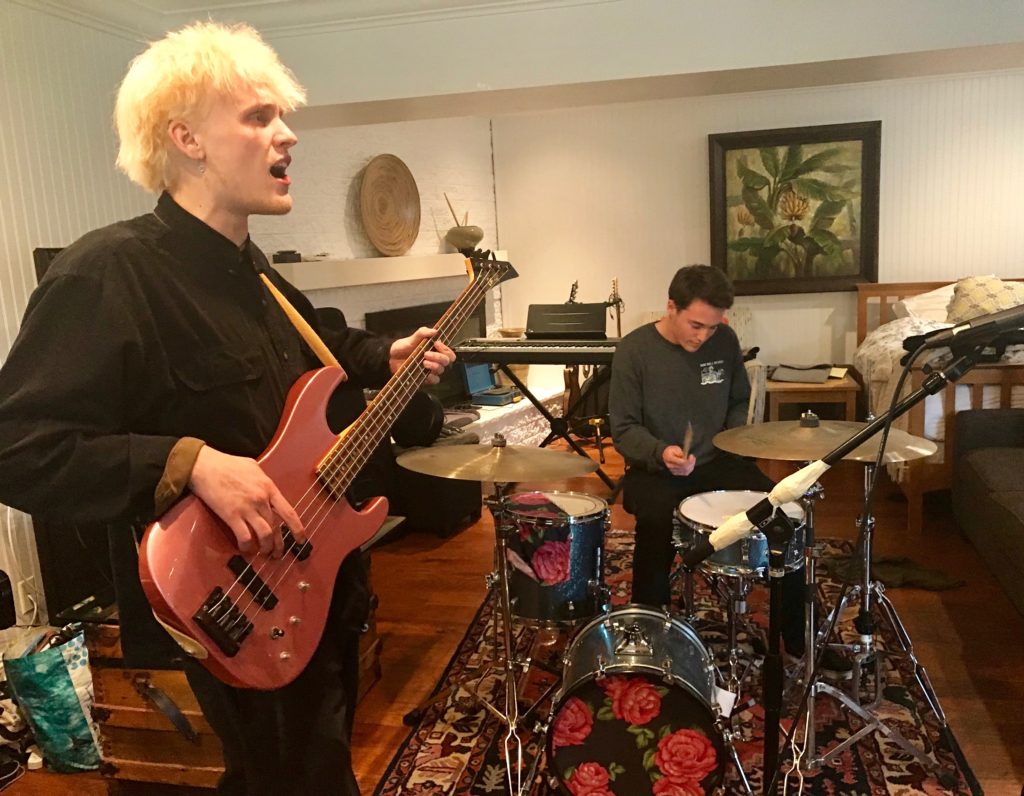
The members of glow!, Dagger De La Vergne, Sophie Parker and Johnny “Blaze” Hurst, respectively rehearse during a session on April 5. Photo by Angelica Wallingford.

The duo was looking for a drummer when De La Vergne met Hurst at a Street Surfers and Foxhide show at local venue Queen Bee’s. Hurst, who has a background playing for other local bands in San Diego, also knew Sophia from high school. With the addition of Hurst, the band has been playing shows since December and consistently writing songs since May 2018.

“We just like clicked and he started playing drums for us and the whole band just came together at that point,” De La Vergne said. “He just added a million times more dynamic…”

In a house atop a hill in La Mesa a residential space is turned into an impromptu rehearsal area. In between the couch and the TV stand sits a drum set. To the right of the front door, chords wind the hardwood floor plugged into the amplifiers and tuners. Next to the amps, lone microphone stand where Parker and De La Vergne will switch lead vocals come practice time.

Amongst the chaos of chords and guitar pedals, Hurst sets up his drum kit placing a shirt as a muffler atop his snare, which he later tosses aside before playing one of the band’s songs. He runs through the percussion part of a song that he was working on before they jump into their first song for the hours long rehearsal.

The band’s experience in the local music scene has been overall a good experience, De La Vergne claims. The problem, he says, lies within the organization of shows and the lack of venues to showcase local artists.

“Collectively, I think there’s a lot of good music that comes from here and I love a lot of the bands that come from here,” De La Vergne said. “At the same time it is pretty messy and inconsistent, not together and not really organized.”

FEW AND FAR BETWEEN

The band points to something that is usually central to a thriving music and arts scene: venues, or in San Diego’s case, a lack thereof.

“If you’re a local band and you’re looking for a venue it’s such an uphill battle,” Shrem-Besnoy said. “There’s just not venues… and I think that’s why the music scene has such a hard time getting legs.”

One of the main problems the members of glow! point out is the seemingly impossible list of requirements that bigger venues have in order for bands to play there. The perspective of bands and artists with smaller followings, the bigger venues tend to focus more on the money the can make from a show rather than just getting the music out there. How many people can the band get to attend and presale tickets are just some of the factors that can make or break a band playing these bigger venues.

One solution that many local groups have come up with to combat the lack of venues is to create their own in the form of house shows. Turning their living space into a functioning venue, holding the capacity crowds that would have otherwise turned up at these smaller venues like the Che Café.

“It’s kind of inhibiting to people like us who are smaller trying to get our name out there, we have all these requirements that we don’t meet for them,” Hurst said. “Everybody is doing house shows because all the venues around here are way to demanding.”

Promoter Héctor Castro, 19, at Chicano Park discussing the San Diego music community on April 18.
Photo by Angelica Wallingford

When the Che Café closed for renovations a few years ago, 19-year-old promoter Héctor Castro didn’t know where he could throw shows that the longtime San Diego establishment once held on a regular basis but also bring together the community that once frequented these shows.

“That really put a roadblock for us because we love to perform, we love to throw shows, we love to have spaces where people can hang out, where we can see our friends,” Castro said. “We didn’t know where to go, so we started throwing house shows.”

While house shows have become a mainstay across San Diego County, it comes with it’s own set of problems. The main being that these DIY shows are located in residential areas and often times can be unorganized, De La Vergne said.   

Kalani Lomu, formerly of longtime San Diego band Bad Kids, has been active in the scene since 2011 and has played in most of the venues scattered throughout San Diego. For Lomu, it’s not the lack of venues that are the problem; it’s the lack of all-ages venues that are the real issue since most bars can double as a performance space.

“The young kids make up a lot of the show goers in the scene and yet there’s like three all ages venues,” Lomu said. “For young bands it’s really not fun being escorted into the venue by the bouncer and then have you kicked to the curb after your set.”

MONEY TALKS

Aside from the lack of venues being an issue for most bands, another issue is the music business in San Diego and the lack of accessibility for people of all backgrounds to participate, according to Castro.

“I live in San Yisidro, I’m not rich, I’m not even in the middle class, I’m not even in the low middle class. I can’t afford to throw $1000 into shows,” Castro said. “It would be amazing to have smaller spaces that can see that and say ‘we have money, we have these promoters that can help you throw these shows and have them happen, we can have spaces that help you have a performance,’ it would be amazing if we had more of that because we don’t.”

The issue of profiting from artists isn’t something particularly new when it comes to music scenes anywhere. The concept of “pay to play” has been used in venues for so long that it’s become almost expected and is something that Shrem-Besnoy disagrees with completely.

Dagger De La Vergne and Johnny “Blaze” Hurst practice during an April 5 session. Photo by Angelica Wallingford

“These people come out to see the bands on the stage,” Shrem-Besnoy said. “They (the bands) deserved to get paid because if it wasn’t for them people wouldn’t be coming to the venue.”

Castro started producing shows when he was 17, at the time he considered it to be a great opportunity because he knew the bands he was booking and the venues to hold the events. At that time, because of his connections, it didn’t cost anything for him to put on an event.

However, with his past two shows he decided to invest about $600 of his own money to create an ambiance for his productions that other venues wouldn’t have otherwise been able to accommodate. Castro took it as a risk because he didn’t know whether he would make a return on his investment and pay out the bands that performed.

“It is kind of a weight on me because I know that if no one shows up, I’m going to have to pay out of my pocket and I end up losing money and hurting me,” Castro said. “It scares me from throwing more shows because I don’t know if its going to be helpful for the community or I’m just going to crumble down and not be able to give more to the community.”

COMMUNITY THROUGH DIVERSITY

For Castro, Shrem-Besnoy, Lomu and the members of glow! the San Diego music scene is more than just a bunch of artists showcasing their work, it’s a community with music just as diverse as the people that make it.

Johnny “Blaze” Hurst and Sophie Parker, members of the local band glow!, rehearse in a converted living space on April 5. Photo by Angelica Wallingford

“One thing about San Diego is that there’s everything here. Going off of bands there’s Beach Goons, they’re like surf rock. You have hardcore bands like frontside… You have things like Sestivity, which is going in a new direction that mixes keyboards and MIDI controlled sounds into their punk music. And then you just have contemporary rock such as Street Surfers, Wizard and all those guys. Then you have rappers, 1207 is huge,” Hurst said. “They’ve made a name for themselves all out of San Diego.”

While San Diego’s music scene might not be as big as the one in Los Angeles, it doesn’t mean that the culture isn’t there and music plays a huge part in that, Lomu claims.

“There’s so much different music coming out of this place it’s honestly hard to keep track of,” Lomu said. “We might not be known as a ‘music city’ but honestly we probably should be.” 

glow! band profile. Filmed and edited exclusively on iPad Pro.
css.php